About The Kaʻū Calendar

Friday, July 21, 2023

Kaʻū News Briefs, Friday, July 21, 2023

Kenneth Makuakane, the songwriter and musician will entertain at the Hawai'i Volcanoes National Park's 39th Annual Cultural Festival, tomorrow, Saturday, along with Da Kahuku Mauka Boyz with Russel Mauga; The Kīpapa Sisters; Keaīwa; Hālau o Leionalani and LoriLei’s Hula Studio. Photo from PBS. See https://www.youtube.com/watch?v=j9XZa_KAaXY

THE 39TH ANNUAL CULTURAL FESTIVAL FOR HAWAI'I VOLCANOES NATIONAL PARK is Saturday at Kahuku from 10 a.m. to 3 p.m. It features Hawaiian and island-inspired music, hula, Hawaiian
cultural demonstrations and ono kine grindz available for purchase (or pack a picnic).
    Activities include throwing a rope like a paniolo with Kaʻū 4H Club; learning about paniolo life at Kaʻū Multicultural Society's exhibit; learning about Hawaiian medicinal plants with Momi Subiono; creating a ti leaf lei; ulana (weaving) a lauhala keepsake with na wahine of ‘Aha Puhala o Puna; and testing skills at pa‘ani (Hawaiian games) led by park rangers. 
    Entertainment includes: Singer/songwriter/musician Kenneth Makuakāne; Da Kahuku Mauka Boyz with Russel Mauga; The Kīpapa Sisters; Keaīwa; Hālau o Leionalani and LoriLei’s Hula Studio.
    Entrance and activities are free. Vendors include Hawaiian food truck 4 Scoops of Aloha, and the Hawaiian Civic Club of Kaʻū, which will sell lunch plates. 
    The Friends of Hawaiʻi Volcanoes National Park will give away free ice shave minis and will sell the official 2023 festival T-shirt.
    Participants can learn more about local conservation and sustainability efforts at exhibit tents sponsored by organizations that include Birds Not Mosquitoes, Rapid ʻŌhiʻa Death (University of Hawaiʻi Mānoa), and the Hawaiʻi Ulu Co-Op. 
    Park staff will lead short walks to the Kaʻū agricultural field system. This fun-filled, family-friendly day is a drug- and alcohol-free event. Sunscreen and a hat are recommended. Bring water, rain jacket, and mat or chair. Kahuku is at the 70.5 mile marker off Highway 11 in Ka‘ū.


PATHWAYS TO A NET-ZEO CARBON ECONOMY BY 2045 is subject of a new study commissioned by Hawaiian Electric. It "makes clear  that major technological advances, especially in sustainable fuels and carbon-capture, and reaching consensus on landuse policy are some of what’s required for Hawai‘i to fully decarbonize over the next 22 years," says a statement from the utility.
      State law mandates a 50% reduction in greenhouse gas emissions by 2030 compared to 2005 levels and for Hawai‘i to be net-zero by 2045. With time running short to meet these targets, the new pathways
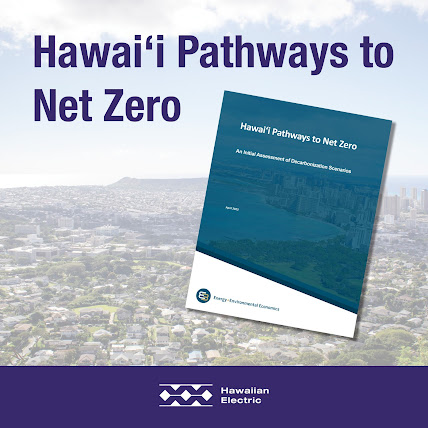
study advises that aggressive actions will need to be underway by 2030 to create a glide path to full decarbonization that is less steep than if actions are delayed. 
    “This study is the first of its kind for Hawai‘i and we commissioned it to understand the scale of decarbonization required in every sector of our economy and the scope of work needed to be successful over the next two decades,” said Shelee Kimura, president and CEO of Hawaiian Electric. “We want to ensure we deliver on our part in this interdependent effort for our state. Renewable energy is required but that alone doesn’t get Hawai‘i to the finish line. The study confirms that success requires contributions from every individual and every industry. We’ve made a lot of progress already by working together and we offer this report to policymakers, researchers, planners, businesses, organizations and individuals as a conversation starter and as a resource for creating action plans across all sectors of our economy.”
     Using data collected from the five islands served by Hawaiian Electric, the analysis charts the sources of emissions tracked by the state’s greenhouse gas inventory, including electricity, aviation, vehicles, industry, buildings, agriculture and waste. Electricity generation accounts for 27% of emissions. Transportation generates 48% of emissions, including aviation, ground, marine and military uses, compared to 28% for the rest of the U.S., highlighting one of the unique challenges to decarbonizing the island economy. 
   The study finds that energy efficiency and reducing the demand for energy are “crucial” in achieving short- and medium-term emission reductions and reducing the amount of land that will be needed for future renewable energy projects. Hawaiian Electric worked with Energy and Environmental Economics (E3), a nationally recognized consulting firm that has conducted similar studies for the California Energy Commission, the U.S. Climate Alliance and many utilities and government agencies. Hawai‘i Pathways to
Net Zero – an Initial Assessment of Decarbonization Scenarios
 builds on Hawaiian Electric’s Climate Change Action Plan, which commits to reducing greenhouse gas emissions from its operations 70% by 2030 compared with 2005 levels. 
    According to Hawaiian Electric, the study isn’t intended to suggest approaches to achieving net zero but explores what might be needed in terms of energy infrastructure, technology adoption and supportive public policies. In 2022, the Hawai'i Legislature tasked the State Energy Office with undertaking a similar study to “analyze pathways and develop recommendations for achieving the state’s economy-wide decarbonization goals.” 
    Hawaiian Electric said it provided its pathways study to the state and key policymakers as a potential resource to help inform the state’s work. “Hawaiian Electric deserves credit for taking a holistic view of carbon impacts among all sectors in its Pathways to Net Zero study that can serve as a basis to inform future policies and actions,” said Mark Glick, the state’s Chief Energy Officer. “With the State Energy Office’s intention to also investigate energy costs, sectoral workforce impacts and recommendations for next steps, the back-to-back decarbonization analyses might be considered a one-two punch to counter the harmful effects of carbon-intensive energy in Hawai’i.” Hawaiian Electric commissioned the study to advance its Climate Change Action Plan. The study explores the utility’s role in decarbonizing the economy and how its targets align with actions in other sectors. Hawaiian Electric asked E3 to develop long-term, economywide decarbonization scenarios that would show how Hawai‘i’s 2045 target could be achieved. 
     Hawaiian Electric says that "Among the key findings of the pathways study that could drive action are: • Renewable electricity generation is necessary but not sufficient by itself to meet Hawai‘i’s decarbonization goals. • The electrification of transportation and industry will significantly increase the amount of electricity that needs to be generated. Demand for power would at least double by 2045. • Electrification is a key driver in decarbonization of ground transportation but in aviation and marine transportation decarbonized fuels will be required. • Even with 70% electricity decarbonization and ambitious efforts in other sectors to achieve statutory greenhouse gas reduction targets, more aggressive near-term actions will likely be required to hit the state’s 2030 target of 50% GHG reductions. • Carbon dioxide removal – also called carbon sequestration – will be required to achieve net zero, either through increased natural sinks or negative emissions technologies. • Energy efficiency and conservation are crucial in supporting the net zero goal by reducing the amount of renewable electricity and fuels that must be procured.
    Hawai‘i Pathways to Net Zero – an Initial Assessment of Decarbonization Scenarios is available at hawaiianelectric.com/decarbonization.


HPD IS STILL SEARCHING FOR TANAIYAH HAO-KALLIO who is known to frequent Kaʻū. The Hawa'i Police Department detectives described her as 5 feet 5 inches tall, 140 pounds, with brown hair and brown eyes.
    Police ask anyone with information on the whereabouts of Hao-Kallio, or other runaways, to contact the Hawai'i Police Department’s non-emergency number at (808) 935-3311.
    Tipsters who prefer to remain anonymous may call the island-wide Crime Stoppers number at 961-8300 and may be eligible for a reward of up to $1,000.00. Crime Stoppers is a volunteer program run by ordinary citizens who want to keep their community safe. Crime Stoppers does not record calls or subscribe to any Caller ID service. All Crime Stoppers information is kept confidential.

Five thousand in the mail, 2,500 on the street.
See the July edition of The Kaʻū Calendar Newspaper


Kaʻū News Briefs, Thursday, July 20, 2023

Kaʻū Forest Reserve. Photo by Rob Shallenberger
INVASIVE PLANTS DOMINATE THE UNDERSTORY OF HAWAI'I FORESTS, according to a new study by the U.S. Forest Service called How Invaded are Hawai'i's Forests? It notes that natives are the largest trees in the forests but the next generation of trees growing under them are mostly non native. It predicts "a more dire future for native plants in Hawaiian forests than has been previously described" and points out that fresh water comes from forests that create the watershed.
Christian Giardina worked on
the study and is based at U.S.
Forest Service in Hilo
     The study predicts that 75 percent or more of Hawai'i's forest canopy species in the future will be nonnative. The subtitle of the study is Nonnative understory tree dominance signals potential canopy replacement. It is published in the latest Landscape Ecology journal.
    The abstract says, "Non-native species invasions are altering the composition, structure, function, and dynamics of forests globally. The Hawaiian Islands are a global biodiversity hotspot for non-native invasive plant species. New spatial inventory data for forests of Hawaiʻi can provide insights into invasive species presence and dominance across complex landscapes."
    The Forest Service researchers employed a network of 238 standardized plots spanning climate and soil gradients to conduct the first comprehensive assessment of non-native plant invasions in forests of Hawaiʻi. "We examined non-native plant dominance from the forest floor to canopy to understand how invasion related to environmental and management-related factors."
     The scientists tested whether significant differences in non-native dominance across forest strata existed based on ownership/management, fenced status, island group, and forest type.
    Across forest types, non-native tree species accounted for 30 percent of large tree stems, 65 percent of sapling stems, and 67 percent of seedling stems. The study found that low-elevation forests were particularly degraded, but even montane forests were widely impacted and may become more so following forest disturbance. 
Based at U.S. Forest Service in Hilo, Dr. Susan
 Cordell is one of the authors of the study
showing invasives taking over Hawaiian forests.
      Forests on public lands, in conservation reserves, or in fenced areas were less impacted by non-native trees and shrubs, indicating possible benefits of conservation management.
     The study concluded that "patterns and processes of plant invasion in Hawaiian forests provide data for the conservation of Hawai‘i’s unique flora and insights into how invasion trajectories may play out in other forests." It noted that damage from pigs, goats and other ungulates has doubled in the last seven years. It also mentioned wildland fires, climate change and Rapid ʻŌhiʻa Death as mounting threats. 
      Kaʻū has the largest amount of land in native forests in all of Hawai'i with ownership by the state, federal government, Kamehameha Schools and The Nature Conservancy.
    The U.S. Forest Service for Hawai'i is based on the campus of University of Hawai'i in Hilo with its Institute of Pacific Island Forestry. Authors of the study are Kevin M. PotterChristian GiardinaR. Flint HughesSusan CordellOlaf KueglerAmy Koch and Emma Yuen.
     
HOW HVO MONITORED KILAUEA IN THE PAST is the focus of this week's Volcano Watch written by scientists and affiliates of Hawaiian Volcano Observatory:
    We can learn about how the Hawaiian Volcano Observatory monitored Kīlauea prior to and during the 1967-68 Halema‘uma‘u eruption by reading reports documenting activity at that time. HVO staff then
A telephoto image of vents erupting on the floor of Halema‘uma‘u
 crater, at the summit of Kīlauea, in 1967. NPS photo by C. Stoughton.
wrote, “The current eruption in Halema‘uma‘u is especially interesting because events seem to be following the same general pattern that was recorded again and again during the pre-1924 Kīlauean activity.”
    In March and December 1965, middle East Rift Zone eruptions occurred which partially drained the magma storage system at Kīlauea summit and caused modest subsidence. The 2018 lower East Rift Zone eruption of Kīlauea drained the summit magma chamber on a larger scale, resulting in caldera collapse.
    Similar timeframes of quiet, non-eruptive periods ensued at the summit of Kīlauea following the 1965 and 2018 eruptions. About two years after each eruption, the summit magma reservoir recharged and eruptions occurred.
An aerial overview of Halema‘uma‘u crater erupting in early December 1967.
 USGS image.
    HVO staff wrote that the 1967-68 eruption was preceded by only about “one hour of gradually increasing harmonic tremor…though the eruption has been ‘expected’ for over a year.” Gradually increasing earthquake rates and inflation over the months prior signaled to HVO staff that an eruption could be coming.
    Likewise, modern HVO has monitored increasing rates of earthquakes and ground deformation for weeks to months prior to the recent eruptions at the summit of Kīlauea. The immediate harbinger of these eruptions has occurred within a similar timeframe of about an hour, as ascending magma breaks rock and causes seismicity.
    In 1967, HVO had 12 seismometers and two tiltmeters monitoring Kīlauea’s summit. Though the seismometers were telemetered to the observatory, the tiltmeters were done by hand, being read manually every two-to-twelve hours.
A telephoto image of vents erupting on the floor of Halema‘uma‘u
 crater, at the summit of Kīlauea, in June 2023. USGS image 

    Today, HVO’s Kīlauea summit monitoring network includes similar numbers of seismometers (18) and tiltmeters (4), but it has expanded to include other monitoring datasets. For example, GPS stations record three-dimensional ground motion, gas-stations record volcanic gas emissions and other meteorological data, gravimeters track accumulation and loss of magma beneath the surface, a laser rangefinder tracks elevation of the crater floor, and webcams capture imagery (visual and thermal) documenting changes on the surface and eruptive activity.
    Compared to the manual data monitoring of 1967, telemetry advancements and digitization allow HVO scientists to observe near real-time monitoring data remotely. Much of these data are available to the public on the HVO website, including the popular livestream camera.
An aerial overview of Halema‘uma‘u erupting in late September 2021.
USGS image.
    In their 1967 eruption reports, HVO staff observed that “Halema‘uma‘u is in the process of being filled.” The eruption, which began on November 5, 1967, went on for another 251 days and filled about 370 ft of lava in the crater (113 m). Post-2018 eruptions within Halema‘uma‘u, which began in December 2020, September 2021, January 2023, and June 2023, continued for two weeks to over a year, and have filled the crater over 1,270 feet (387 m) in total.
   Tom Wright and Fred Klein, in their 2014 publication noted of HVO in the 1960-70s, “Along with improved instrumentation and methods came increased challenges to the HVO staff as eruption frequency underwent a dramatic increase.”
    HVO staff today have seen similar improvements in monitoring and research, especially with funding supplied through the Additional Supplemental Appropriations for Disaster Relief Act of 2019 (H.R. 2157). Eruptions over the past several years, which include the several at Kīlauea summit and one on Mauna Loa, have certainly kept HVO staff busy, but have also provided unprecedented opportunities for learning and strengthening relationships with our partners and communities on the Island of Hawai‘i.
    Similarities can be drawn between Kīlauea’s behavior prior to 1924 and discrete other periods, including the 1967-68 eruption and the 2018 summit collapse and subsequent refilling eruptions. These examples are a good reminder that a volcano’s past behavior can offer clues as to how it might behave in the future.
    Volcano Activity Updates: Kīlauea is not erupting. Its USGS Volcano Alert level is ADVISORY.
Active lava has not been visible within Halemaʻumaʻu crater at the summit of Kīlauea since June 19. Earthquake activity in the summit region has been low over the past week. Summit tiltmeters generally showed gradual inflation for much of the past week. A sulfur dioxide (SO2) emission rate of approximately 104 tonnes per day was measured on July 17.
    Mauna Loa is not erupting. Its USGS Volcano Alert Level is at NORMAL.
    Webcams show no signs of activity on Mauna Loa. Seismicity remains low. Summit ground deformation rates indicate slow inflation as magma replenishes the reservoir system following the recent eruption. SO2 emission rates are at background levels.
    There were five earthquake with three or more felt reports in the Hawaiian Islands during the past week: a M3.2 earthquake 21 km (13 mi) N of Hawaiian Ocean View at -1 km (0 mi) depth on July 18 at 11:24 p.m. HST, a M3.2 earthquake 10.1 km (6.2 mi) NE of Pāhala at 31 km (19 mi) depth on July 16 at 12:56 a.m. HST, a M3.0 earthquake 12 km (7 mi) N of Puako at 20 km (12 mi) depth on July 13 at 7:56 p.m. HST, a M1.8 earthquake 14 km (8 mi) ESE of Pāhala at 31 km (19 mi) depth on July 13 at 12:38 p.m. HST, and a M4.6 earthquake 97 km (60 mi) NNE of Laupāhoehoe at 28 km (17 mi) depth on July 13 at 11:29 a.m. HST.
    HVO continues to closely monitor Kīlauea and Mauna Loa.

To read comments, add your own, and like this story, see facebook.com/kaucalendar.
See latest print edition at kaucalendar.com, in the mail and on stands.

A MASKED MAN WAS ARRESTED IN OCEAN VIEW WHILE BURGLARIZING A RETAIL BUSINESS wee hours of Wednesday morning. Hawai'i Police Department identified him as 21-year-old
Derick Camacho
Derick Camacho, of Captain Cook, and arrested him for first-degree robbery.
    Around 2:35 a.m. on Wednesday, Ka‘ū patrol officers responded to an active burglary at a business in the 92-8000 block of Māmalahoa Highway. While investigating this burglary, officers were alerted to a second active burglary occurring at a nearby retail establishment.
    Upon entry into the second business, officers discovered Camacho, making verbal threats and physically dragging a 61-year-old male victim into a back room. Officers immediately demanded that Camacho release the victim, however he refused to comply with the officers’ orders. An officer deployed his Conducted Energy Weapon, commonly known as a “taser,” and Camacho was subsequently taken into police custody.
    Camacho was transported to the Kealakehe Police Station where he remains in custody as detectives with the Area II Criminal Investigation Section continue their investigation. A charging decision with additional offenses is anticipated.
    Anyone with information about this case is encouraged to contact Detective Cacique Melendez at (808) 326-4646, ext. 281, or via email at Cacique.Melendez@hawaiicounty.gov.


ACTIVITIES IN AUGUST ARE ANNOUNCED BY OCEAN VIEW COMMUNITY ASSOCIATION: 
    The monthly pancake breakfast is Aug. 12, 8 a.m. -11a.m. at OV Community Center. "Just $7 for a big plate of food and friendly neighbors."
    Yoga classes are Thursdays at 5 p.m. and Sundays at 3:45 p.m. at the Center,
    Aikido Classes are Tuesdays and Thursdays at 6:15 p.m. at the Center,
    Teen Night is the first Saturday evening of the month - Aug. 5 from 6 p.m. to 8 p.m. Pingpong, air hockey, games and snacks.
    OV's County Council member Michelle Galimba from County Council District 6 will hold an outreach event at the OV Community Center on Friday, Sept. 1 at 5 p.m.

Five thousand in the mail, 2,500 on the street.
See the July edition of The Kaʻū Calendar Newspaper


Wednesday, July 19, 2023

Kaʻū News Briefs, Wednesday, July 19, 2023

Aaron Hammer's show reopens at Volcano Art Center on Thursday after a day of being closed, following Tropical Storm Calvin.
 He offers a demonstration on Saturday, July 29 from 11 a.m to 2 p.m., featuring live wood turning on a lathe. Photo from VAC

VOLCANO ART GALLERY REOPENS THURSDAY with the Wondrous Works in Wood show, featuring Aaron Hammer. His lathe-turned works of art will be on display through Aug. 20. The gallery, which opened the exhibition on July 15, shut down Wednesday in the wake of Tropical Storm Calvin. It reopens 9 a.m. to 5 p.m. daily in Hawai'i Volcanoes National Park. The exhibition is free and park entrance fees apply.
    Hammer has scheduled a woodturning demonstration from 11 a.m to 2 p.m. on Saturday, July 29 to allow viewers to witness live woodturning on a lathe. Hammer states that while working on the lathe “one must work from the center both physically and spiritually…starting with a raw log and transforming it into a finely finished and cherished object is the joy of my creation.”
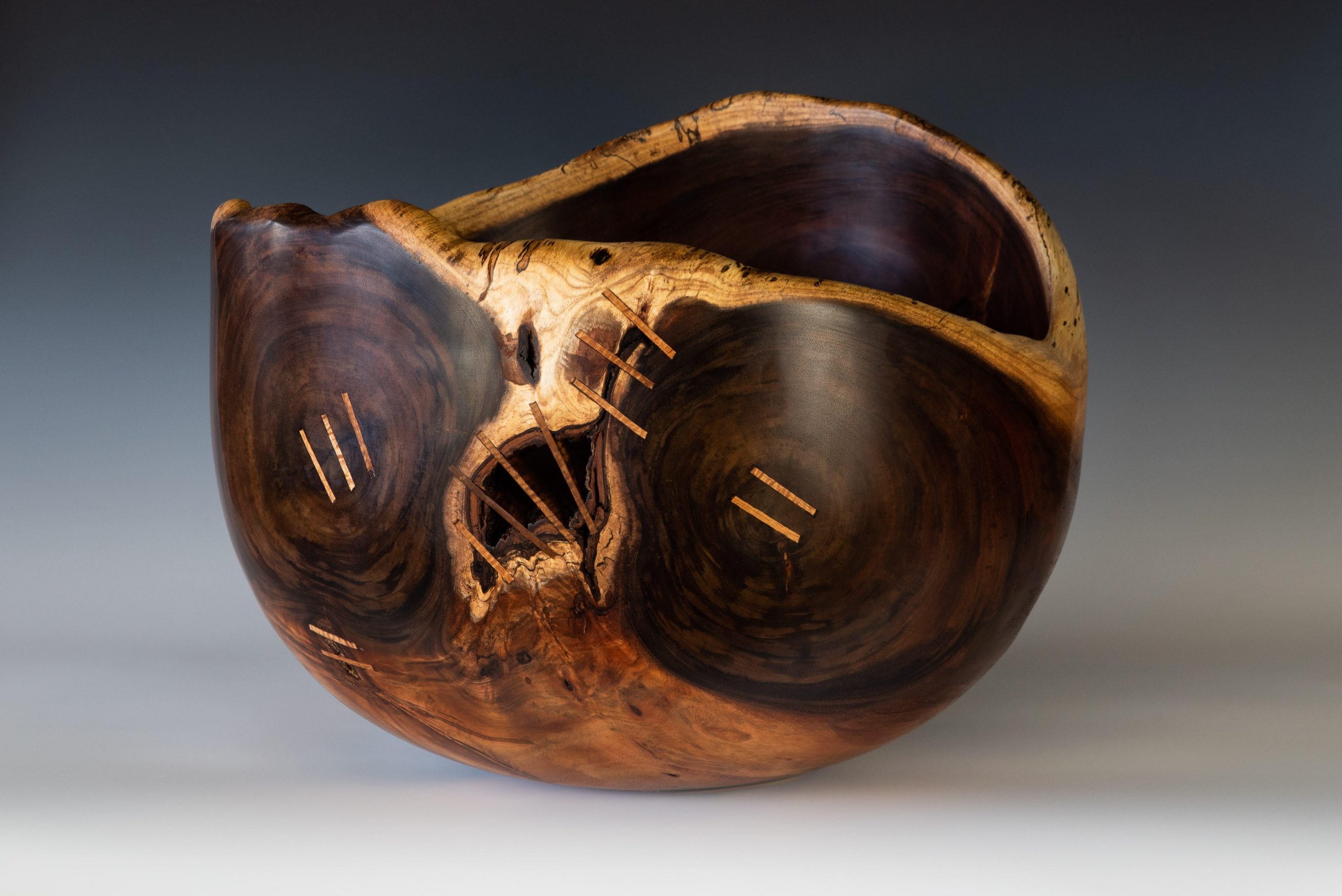
    Wondrous Works in Wood showcases Hammer's newly-finished turned wood made from trees grown in Hawai'i. The works include natural-edged bark lipped bowls, traditional calabash shaped bowls, and large-scale platters. The scale of the pieces range from 8 inches to 36 inches in diameter. Hammer chooses to use previously-fallen Hawaiʻi grown trees in an effort to protect Hawai'i’s cherished forest resources. He states, “In the pieces I create, I attempt to honor these sacred trees by creating heirloom-quality work that is loved by families for generations. The fallen trees or urban-salvaged trees that I work with are often full of flaws, imperfections and defects. I endeavor to embrace these challenges and turn these flaws into unique features.”

An Aaron Hammer creation in the Wondrous Works in Wood exhibition.
Photo from VAC

    Originally from Kansas City, Hammer traveled extensively after high school to destinations including Israel, India, and Nepal and then made the island of Oʻahu his home in 1993. Mentored by  master wood turners Jerry Kermode and Ron Kent, Hammer began operating his own wood turning studio in 2000.
   Hammer now produces a full line of HammerCraft, lathe-turned art and gift items from his studio in Papaikou, which he established in 2014.In addition to running his business,                Hammer has served on the Board of Directors of The Pacific Handcrafters Guild holding the titles of Vice President and President. He is active now on the Board of Directors for the Hawai'i Forest Industry Association and in the local Hawai'i art and wood shows, winning awards at the HFIA wood shows of 2011 and 2022. He said he also loves teaching and has offered wood turning classes in Laupahoehoe. As an instructor he has been invited to teach wood turning workshops at Pratt Art Center in Seattle and was recently invited to teach a third workshop at Arrowmont School of Arts and Crafts in Gatlinburg, Tennessee.
 Park staff urges motorists and hikers
 to be alert for post-Calvin downed branches
 and other possible damage. This large
 branch was on Mauna Loa Road in the Park.
NPS photo
    Visit www.volcanoartcenter.org for more information, or call VAC Gallery at (808) 967-7565. Volcano Art Center is a 501(c) 3 nonprofit organization created in 1974 whose mission is to promote, develop and perpetuate the artistic, cultural and environmental heritage of Hawaiʻi through arts and education.


HAWAI'I VOLCANOES NATIONAL PARK REOPENED WEDNESDAY at 11 a.m. as impacts waned from Tropical Storm Calvin. Kīlauea Visitor Center, park roads and most trails are open the to public.
Ranger programs are suspended Wednesday. Park staff are busy clearing trails, roads and other public facilities following the storm. Visitors should expect that some areas could remain closed while being evaluated or cleared.
    The Kulanaokuaiki Campground, backcountry areas and backcountry office also reopened at 11 a.m.
Nāmakanipaio Campground, managed by the Volcano House, is expected to reopen at 3 p.m. The A-frame cabins remain open. Call (808) 756-9625 for more information.
    While little damage occurred in the park, visitors are advised to remain alert for hazards which include fallen branches and road debris. Be extra cautious in forested areas and on trails. Expect continued wet weather and drive carefully.
     Continue to check the park website at https://www.nps.gov/havo/index.htmand
and social media for updates.


Brown Water Advisory after Calvin. Image from Hawai'i Pacific Health   

A BROWN WATER ADVISORY FROM SOUTH POINT UP THE EAST COAST OF THE ISLAND was issued by the state Department of Health on Wednesday in reaction to runoff from the rains of Calvin.
   DOH Clean Water Branch issued the following statement: Heavy rain has resulted in stormwater runoff entering into coastal waters. The public is advised to stay out of flood waters and storm water runoff due to possible overflowing cesspools, sewer, manholes, pesticides, animal fecal matter, dead animals, pathogens, chemicals, and associated flood debris. Not all coastal areas may be impacted by runoff, however, if the water is brown stay out. Continue to practice good personal hygiene and follow-up with your primary care physician if you have any health concerns."

THE TROPICAL STORM WARNING IS CANCELLED for Hawai'i Island along with a Flood Watch and High Surf and Wind Advisory in the wake of Tropical Storm Calvin. County Civil Defense still urges: "Please exercise caution while the conditions remain unsettled." The storm left some fallen trees and branches but little damage across the island. 

    HPD ARRESTED TWENTY-SEVEN FOR DUI during the week of July 10 through July 16. Hawai'i Island police arrested the motorists for driving under the influence of an intoxicant. Eight were involved in a traffic collision. Three arrested were under the age of 21.
    So far this year, there have been 536 DUI arrests compared with 561 during the same period last year, a decrease of 4.5 percent.
    Hawai’i Police Department’s Traffic Services Section reviewed all updated crashes and found 458 major collisions so far this year compared with 424 during the same period last year, an increase of 8 percent.
    To date, there have been nine fatal crashes, resulting in 10 fatalities, (one of which had multiple deaths); compared with 20 fatal crashes, resulting in 22 fatalities (one of which had multiple deaths) for the same time last year. This represents a decrease of 55 percent for fatal crashes, and 54.5 percent for fatalities. HPD promises that DUI roadblocks and patrols will continue island wide.

To read comments, add your own, and like this story, see facebook.com/kaucalendar.
See latest print edition at kaucalendar.com, in the mail and on stands.

MORE SCREENING AND TREATMENT FOR SYPHILIS IS NEEDED, warns state Department of Health. DOH issued a statement Wednesday, cautioning that the rate of syphilis is increasing in women and newborns. "The continuing rise of cases in women and congenital syphilis is alarming and requires immediate attention."
    Dr. Diana Felton, chief of the Department of Health Communicable Disease and Public Health Nursing Division, said, All sexually active people with risk factors for sexually transmitted infections (STIs) should be regularly tested for syphilis and other STIs. For pregnant persons, we now recommend syphilis screening three times: as early as possible during the first trimester, at 28 to 32 weeks of gestation and at the time of delivery. It is important that sexual partners are also treated to prevent reinfection.
    DOH noted that most cases of congenital syphilis in Hawai'i have been reported in people who received late or no prenatal care. This has led to the health department to urge enhanced screening in health care interactions other than prenatal care.
    "Visits to emergency rooms, urgent care and primary care clinics present critical opportunities to identify and treat syphilis and prevent recurrence of congenital syphilis."
    DOH strongly recommends that women begin receiving prenatal care as soon as they learn they are pregnant, ideally in the first trimester.
    Syphilis can have severe health impacts, especially for developing babies, including increased risk of stillbirth or death shortly after birth, Felton said. The devastating effects of untreated syphilis are preventable if infections are detected early and treatment is initiated promptly.
    In Hawai'i, the number of babies born with syphilis , known as congenital syphilis, ranged from zero to four cases per year from 2000 to 2019, 12 cases in 2020, and 20 cases in 2021. Preliminary data indicates at least 22 cases in 2022. This dramatic increase in congenital syphilis cases is associated with increasing infections in adults.
    The health department is alerting health care providers to be vigilant in screening for cases of syphilis in people who may become pregnant and during pregnancy, and is emphasizing recommendations for diagnosing and treating cases. The department also stresses the importance of treatment of partners to prevent reinfection and follow-up appointments with patients and infants.
    For more information on syphilis infections in Hawai'i as well as screening and treatment recommendations, visit https://health.hawaii.gov/harmreduction/learn-about-diseases/sexually-transmitted-infections/syphilis/.
    Information on syphilis and pregnancy is available at https://health.hawaii.gov/harmreduction/syphilis-pregnancy/.

Five thousand in the mail, 2,500 on the street.
See the July edition of The Kaʻū Calendar Newspaper