About The Kaʻū Calendar

Thursday, September 28, 2023

Kaʻū News Briefs Thursday, Sept. 28, 2023

Pros and cons of a Pāhala sewage treatment plant versus Individual Wastewater Systems for each property
serviced by the old sugar plantation gang cesspool were discussed Thursday at a community meeting led by Brenda 
Iokepa Moses. The County is asking for opinions from the community. Photo by Julia Neal

VOTE FOR A PĀHALA SEWAGE TREATMENT PLANT OR INDIVIDUAL WASTEWATER SYSTEMS IN EACH YARD. County of Hawai‘i asks those with houses on the old sugar plantation wastewater gang cesspool to make a choice. It would be one or the other for everyone affected.
    The county Department of Environmental Management held a meeting Thursday evening at Pāhala Community Center and asked folks to give their opinions. Those who couldn't attend can fill out a survey that was mailed to each affected property owner. Comments can also be sent to codem@hawaiicounty.gov and through https://www.hawaiicounty.gov/departments/environmental-management/pahala-naalehu. 
    The website offers in-depth information on the project, including communications from the federal Environmental Protection Agency, a Preliminary Engineering Report, detailed descriptions of the options and maps. It also includes information on an Environmental Information Document that will explore the
environmental and cultural impacts on the options.
    Pāhala resident and Deputy Director of county Department of Environmental Management, Brenda Iokepa Moses, reviewed the project and opened it up for public discussion.
Sewer treatment plant or Individual Wastewater Systems? Pāhala
 residents weigh in on which way to go. Map of Pāhala Village
 from County of Hawai‘i Department of Environmental Management
     Pāhala resident Gary Domondon said he was concerned that Individual Wastewater Systems for each property could be a solution for the short term but if a sewer system were built later, homeowners on the IWS could be required to hook up and shut down and seal off their Individual Wastewater Systems at their own expense.
    Another speaker asked whether Individual Wastewater Systems installed in each yard would provide the capacity for homeowners to add bedrooms for growing families or build 'ohana units for kupuna in the future, where setbacks and lot sizes allow it. County representatives said that the maximum would be five total bedrooms per house. Planning for adding bedrooms could require bigger leach fields on the properties and each property owner would be involved in the decision.
      Currently, for houses on the old plantation gang cesspool system, additions are prohibited by the federal government until the county closes down the old system and builds a new sewer plant or installs Individual Wastewater Systems for each house. For houses with individual cesspools, seeking permits for adding bedrooms or other additions can trigger the requirement to build a septic system. 
    Another speaker talked about the cost of a sewage treatment plant versus Individual Wastewater Systems. County officials said the treatment plant could cost some $30 million and IWS around $10 million. It was noted however, that the sewage treatment plant could later be expanded to accommodate some growth in the town and to accommodate the ban that goes into effect in 2050 on some 200 individual cesspools in the newer neighborhoods of Pāhala. 
    Money for the chosen option to treat wastewater that goes into the old plantation system could come from county, federal and possibly state funding. For the individual homeowners, county sewer fees are the same across the island, the cost of constructing and maintaining public wastewater systems spread across the communities.
   The options the Department of Environmental Management presented for the public to consider and vote on are:
    A package sewage treatment plant with new sewer pipes collecting wastewater from the homes and carrying it to the plant in sewer pipes under the streets and other public right of ways.
    A package sewage treatment plant using the old plantation collection system with the old sewer pipes. Several speakers during and after the meeting noted the leaky, poor condition of the pipes.
    County Stewarded Individual Wastewater Systems in each yard with a sewer fee for each homeowner. 
    Homeowner Stewarded Individual Wastewater Systems in each yard with homeowners receiving vouchers and hiring contractors, with county overseeing compliance. There would be no sewer fees and owners would be responsible for pumping the septic tanks, perhaps every five years.
    Concerning the Individual Wastewater System option, several speakers during and after the meeting asked about the differences in disturbance to yards between having a sewer pipe to the road and an Individual Wastewater system with leach field. Would the county be responsible for replacing unpermitted structures like garages, cottages, workshops, dog kennels and warehouses where land underneath them would be needed for leach fields to accommodate the Individual Wastewater Systems? A county attorney said the county could not rebuild or pay to rebuild unpermitted structures but could replace such improvements as a rock wall.
    Another option in the county's quest for public opinion allows homeowners to say they don't have enough information to make a choice. They can send questions to the county on the back of the questionnaire sent to each affected homeowner or email codem@hawaiicounty.gov.
    The county website for the project is https://www.hawaiicounty.gov/departments/environmental-management/pahala-naalehu.

To read comments, add your own, and like this story, see facebook.com/kaucalendar. See latest print edition at kaucalendar.com, in the mail and on stands.


NĀ‘ĀLEHU FLOOD CONTROL WATERSHED PROJECT received its annual inspection recently by Kaʻū Soil & Water Conservation District, state Department of Transportation and USDA Natural Resources Conservation Service.
    The Nāʻālehu flood control structure, developed in the mid-1960s is located behind Punalu‘u Bake Shop off Ka‘alaiki Road and makes its way down the slope, exiting below Nāʻālehu subdivision and  Nāʻālehu Park makai of Highway 11. The flood control infrastructure consists of a concrete chute, debris basin, reinforced concrete-lined channel, transition section and 840 feet of unlined channel.
    The flood channel was constructed to convey floodwaters through the village of Nāʻālehu to a disposal area on the porous lava formations in the rangelands. Before the watershed project was completed, flash flooding devastated Nāʻālehu. A statement from Kaʻū Soil & Water Conservation District said:
    "This project not only protects the homes, in the community, it prevents oil erosion and
washing out of agricultural crops and infrastructure important to the farming and ranching community of Kaʻū. Today, we conduct annual inspections of the project, reassuring the community of its safety. We ask all to be mindful of where they dispose of their trash, green waste cuttings, logs, dead animals, animal waste products, and any other waste.
    "These types of unlawful dumping in any intermittent waterway, gulch or stream, will likely cause obstruction in the watercourse and could potentially accumulate at culverts and bridges, resulting in the clogging of these water control structures, preventing the natural water flow and resulting in flooding and erosion.
    "We would like to thank the County of Hawai‘i Department of Public Works Highways Division, USDA NRCS, and the Kaʻū SWCD directors and staff for their dedication, support and annual operations and maintenance of this watershed project."
    For more information, call Jennifer Lopez Reavis, Ka‘ū Soil & Water Conservation Service at 808-933-8350.

To read comments, add your own, and like this story, see facebook.com/kaucalendar. See latest print edition at kaucalendar.com, in the mail and on stands.


HPD ARRESTED 13 FOR DUI from Sept. 18 - 24. Hawai‘i Island police arrested 13 motorists for driving under the influence of an intoxicant. Four of the drivers were involved in a traffic collision. None of the drivers were under the age of 21.
    So far this year, there have been 705 DUI arrests compared with 737 during the same period last year, a decrease of 4.3 percent.

    Hawai‘i Police Department’s Traffic Services Section reviewed all updated crashes and found 604 major collisions so far this year compared with 601 during the same period last year, an increase of 0.50 percent.
    To date, there have been 12 fatal crashes, resulting in 13 fatalities, (one of which had multiple deaths); compared with 24 fatal crashes, resulting in 26 fatalities (one of which had multiple deaths, and one was reclassified to a medical condition) for the same time last year. This represents a decrease of 50 percent for fatal crashes and 50 percent for fatalities.
    To date, the non-traffic fatality count (not on a public roadway) so far this year is one compared to zero non-traffic fatalities for the same time last year. Police promise that DUI roadblocks and patrols will continue island-wide.

To read comments, add your own, and like this story, see facebook.com/kaucalendar. See latest print edition at kaucalendar.com, in the mail and on stands.


Trojans continued a perfect season for Girls Volleyball on Wednesday,
 winning its eighth straight  match. Scoreboard by Jen Makuakane
TROJANS GIRLS VARSITY VOLLEYBALL REMAINS UNDEFEATED for the season, winning all eight of its matches with only three left on the schedule. 
     Trojans posted another win on Wednesday at home against Kanu O Kai ‘Aina in three sets, 25-9, 25-5 and 25-5. Kaʻū Trojans beat Christian Liberty Academy on Monday, 25-17, 25-7, and 25-15. Trojans beat Hawai'i Preparatory Academy last Saturday, 28-26, 18-25, 25-23 and 25-16. JV lost to HPA 17-25 and 15-25.
    On Sept. 16, Kaʻū beat Parker 25-21, 23-25, 25-11 and 25-18. On Sept. 13, Trojans defeated Makua Lani, 25-9, 25-10 and 25 -11. On Sept. 11, Kaʻū beat Kohala 25-14, 25-15 and 25-18.
    On Sept. 8, Kaʻū beat Lapahoehoe 25-7, 25-6 and 25-4. On Aug. 30. Kaʻū  beat Pahoa 25-11, 25-10 and 25-20.
    The next match is at St. Joseph's in Hilo at 10 a.m. on Saturday, Sept. 30, followed by the last home game, playing Ka Umeke Ka'eo Charter School on Wednesday, Oct. 11. The final match is at Honoka'a on Friday, Oct. 13.

Wednesday, September 27, 2023

Kaʻū News Briefs Wednesday, Sept. 27, 2023

OK Farms is a member of Hawai‘i Island Food Hubs, along with Adaptions, Hawai‘i Ulu Cooperative, Ho‘ōla Farms, 
The Food Basket and Kohala Food Hub. Photo from OK Farms
OLSON KEOLANUI FARMS IS A MEMBER OF HAWAI‘I ISLAND FOOD HUBS that buy, sell and move locally produced foods that feed families. On Tuesday, the statewide Hawai‘i Food Hubs Hui named six entities on this island, stating that not only does their locally produced food reach many families, it also becomes star items on restaurant menus. Other members of the Hawai‘i Island Food Hubs include Adaptations, Hawai‘i ‘Ulu Cooperative, Ho'ōla Farms, The Food Basket and Kohala Food Hub.
    OK Farms, a for-profit entity, was founded in 2002 and states its mission is to perpetuate sustainable ag in Hawai‘i. Ed Olson, who farms thousands of acres in Kaʻū and owns Kaʻū Coffee Mill above Pāhala, works with the Troy Keolanui family to also farm nearly 1,000 acres alongside Wailuku River in Hilo.
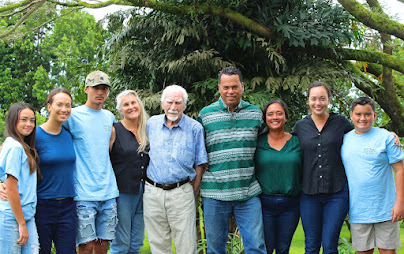
Ed Olson and Troy Keolanui (center) with family at OK Farms,
a member of Hawai‘i Island Food Hubs. Photo from OK Farms
  "Folks need to understand that buying local agricultural products is our only path to food sustainability," emphasized Keolanui. "The learning curve is steep and hard to achieve."
    Hawai‘i Island Food Hubs reported that OK Farms Food Hub works with 60 farmers to collect fruits and veggies for island restaurants and its CSA Food Box program. Weekly or twice-monthly Community Supported Agriculture SA subscribers sign up to receive a box of freshly harvested produce with a recipe and they have the option to change produce selections online. Boxes can be picked up at the farm and OK Farms offers free delivery to nearby offices in downtown Hilo and home delivery for a fee. OK Farm's main crops are lychee, longan, coffee, citrus, heart of palm and spices. The farm sells its produce to a variety of food hubs while also operating the OK Farms Food Hub, on-site OK Farms Store, and agriculture-themed tours through its Hawai‘i Eco Experience.
    "Food Hubs are the cog in the wheel of our local food system," said Rachel Kaiama, destination
manager of the Island of Hawaiʻi Visitors Bureau. "They are the engine improving our local food security." The Hawaiʻi Tourism Authority's Destination Management Action Plan (DMAP) for Hawaiʻi Island, supports and promotes agritourism initiatives to connect local producers with visitors and encourages the visitor industry to buy local produce, products and goods.
    According to Kea Keolanui, OK Farm's Food Hub started in 2020 when the arrival of COVID put a halt to its ag tours. "We had four empty vans and we put them to use by transporting produce and operating a food hub," she explained. Now that visitors are back and tours have resumed, OK Farms is continuing in its food hub role.
    "Our goal with the food hub is to increase the purchasing of local food here and in turn increase production of food because the demand needs to be there," Keolanui continued. "It's an idea and way of living we need to have. Living on an island, it's critical to support our local farmers because they help us
Rachel Kaiama, of Hawai'i Tourism Authority,
 said Food Hubs are "the engine improving our 
local food security,"
in times of need, like during the pandemic. If planes bringing tourists and fresh produce stop coming, we don't get fresh food."
    Jill Dorsey, of Hilo, signed up for OK Farm's Farm Box program during COVID to help support local farms that lost their ability to supply food to chefs due to restaurant shutdowns. "After having joined, OK Farms helped us realize the importance and impact of local farming. Beyond the excellent quality of the food, we choose to continue with the CSA to support local farms. It is an ono and pono choice for us." For info, www.hawaii-eco.com.boxes, weekly online markets and local commodity distribution to grocers, restaurants and resorts.
    Hawai'i Island Food Hubs reported that "The island's food hubs are located in Kona, Kohala and Hilo. Each has a different focus and distributes food differently but all make accessing local food easy and convenient. Some participate in SNAP/EBT (Supplemental Nutrition Assistance Program/Electronic Benefit Transfer) and DA BUX Double Up Food Bucks to offer a discount on qualifying SNAP purchases.
    "Moving fresh food in a timely manner, the hubs find buyers so the farmers and ranchers can focus on producing food while being ensured their hard labor will not go to waste. That in turn, encourages farmers to produce more food as they know it will be purchased."
    Adaptations is the state's oldest food hub, operating as certified organic farm and a food hub with statewide distribution to CSA subscribers, restaurants and grocers. The for-profit company carries an average of 450 local food products that vary seasonally, sourcing from 180 small and medium-sized farms on Hawai'i Island and Maui. Owner Tane Datta and daughter Saffron also offer a line of crafted botanicals.
    "Our marketing and distribution operations connect growers of all scales with consumers of all scales," noted Adaptations co-owner Maureen Datta. "Our primary goal is to retain and expand the acres of land in
food production by serving family farmers, gardeners and backyard growers with aggregation, distribution to market and education about quality control and packaging."
    Adaptations' Fresh Feast CSA offers island-wide users a variety of options: weekly or twice-monthly subscriptions, pick-up locations and payment plans, including SNAP/EBT. Subscribers receive an automated email detailing each week's pre-selected produce box and they can remove and replace contents via their online "cart," or add additional items like pizza dough found on the Fresh Feast webstore. There's a producer profile and description for every webstore item and recipes are shared via the automated email.
    Lindsey Isola of Kailua-Kona has been a Fresh Feast subscriber for almost two years. She and her husband moved here from California, where they used a CSA "to eat fresh, nutrient foods and support local farmers." The fitness and wellness coordinator at the Four Seasons Resort Hualālai Spa easily picks up her Fresh Feast box at work where a drop-off location services Four Seasons employees. Full- and part-time Hualālai Resort residents get Fresh Feast home delivery for a nominal fee and Adaptations allows part-time residents to put their subscription on hold when not in town.
    "When I started using Fresh Feast, there were unfamiliar produce items and things missing like the fresh apples I got in California," recalled Isola. "But then I changed my way of thinking, telling myself 'here's new foods to try that I otherwise wouldn't have chosen—like lilikoi (passionfruit), starfruit and dragon fruit.' Now I love the variation and especially like to use the Tokyo turnips rather than potatoes—they have an earthy sweetness that reminds me of celery root or kohlrabi. I love the Okinawan sweet potatoes, all the greens, heirloom carrots and tomatoes. These are cool offerings that get you excited!" For info, https://adaptationsaloha.com.
    Ho‘ōla Farms was founded in 2015 as Ho‘ōla Veterans Services with the mission to support military vets and their families entering agriculture. In addition to Ho‘ōla's Groundwork to Grow ag and business

training, the non-profit operates an agribusiness incubator kitchen with storage rental and the Hawai‘i Farm-to-Car online farmer's market.
    Hawai‘i Farm-to-Car customers shop a weekly virtual market of local produce, meats, eggs, cheese and value-added products. Weekly curbside pickup is at distribution sites in Kea‘au and Pepe‘ekeo. The program accepts SNAP/EBT and DA BUX. No subscription is required to participate.
    Over the last three years, the market has seen increased sales of $145,000 from 54 producers in 2021, to $275,000 from 82 producers in 2022, reaching over 800 unique customers and $40,000 in SNAP/EBT sales.
    "Our goal is to support the development of local farmers and producers, increasing our local economy and community resilience, and decreasing our reliance on imported food," said Emily Emmons, executive director of Hoʻōla Farms. For info, www.hoolafarms.org.
    The Food Basket DA BOX CSA provides food assistance to those in need and operates the non-profit Food Basket DA BOX program as a CSA with island-wide distribution. In 2022, DA BOX worked with 55
different farmers to distribute seven to eight fresh produce items to 693 weekly and twice-monthly subscribers.
    DA BOX began in 2014 as the first CSA in the state to accept SNAP/EBT benefits and to provide a discounted rate to SNAP customers. According to Chelsea Takahashi, the Food Basketʻs director of Healthy Food Access Initiatives, DA BOX offers a buy one, get one free model or matches each bag purchased with SNAP benefits with a free bag. DA BOXES are conveniently distributed at the hub's Hilo warehouse and at multiple pickup points around the island. For info, phone the hotline, at 808-796-3091 or visit www.hawaiifoodbasket.org/da-box.
    Hawai‘i ‘Ulu Cooperative doesn't offer CSA subscriptions and is for-profit, but is considered a food hub as it connects numerous local farmers with consumers, but in a different way.
"HUC has aggregated over 1.5M pounds of local crops since established in 2016," according to HUC
manager Dana Shapiro. She added that co-op farmers steward 6,000 'ulu (breadfruit) trees and expect to harvest 1M pounds of 'ulu per year by 2030.
    The 150-member cooperative focuses on starch or staple crops—‘ulu, kalo, sweet potato and kabocha squash—and manufactures them with little processing. Examples are frozen and partially cooked, recipe-ready pieces of the staple crops and prepared hummus, mousse and flours. The co-op serves as a wholesaler, selling these products to island food hubs, grocers, restaurants, schools and other institutions, and is an approved DA BUX vendor at participating stores. Residents wishing to purchase products can find where they are sold using the product locator on the co-op's home page, https://eatbreadfruit.com.
     Kohala Food Hub non-profit offers locally grown produce and value-added products from 103 producers to island restaurants and services North Kohala, Waimea and Waikoloa residents through its weekly Multi-Farm CSA subscriptions and Online Marketplace. Most of the hub's farmers are small-scale, "backyard growers that use regenerative and organic farming methods" according to Maya Parish, Kohala Food Hub director.
   CSA members are reserved a weekly box of pre-set produce and receive an email announcing other products that can be added if desired. Another option, the Online Marketplace, enables shoppers to pick and choose from over 200 products on KFH's website.
    "The online marketplace is just like shopping on Amazon but for products grown here on island," said Parish. A CSA subscription is not required.
    Multi-Farm CSA subscribers are privy to exclusive, seasonal produce not available on the online market and they can add products from the Online Marketplace too, including meat, eggs and baked goods. A regular or larger family subscription can be purchased and a frequency chosen of weekly or twice-monthly.
    Parish said KFH distributed close to 33,000 pounds of food in 2022 and is expecting "an expediential increase" for 2023. In addition to its CSA and Online Marketplace, the hub accepts SNAP/EBT, offers a Veggie RX free food access program for qualifying residents, and plans to launch a mobile market this fall.
    "The mobile market will meet residents where they are, eliminating transportation barriers," noted Parish. "It will be stocked with value-added products and produce and make using the hub super convenient."
    Sandy Eisenberg, a nearly full-time resident of the Mauna Kea Resort, likes to shop from KFH's Online Marketplace. "I don't have to order every week and the portions are about right for a couple," she noted. "I can adjust my order when family members are here on island and it's convenient to pick up my order at the Kawaihae Market." For info, www.kohalafoodhub.com.

To read comments, add your own, and like this story, see facebook.com/kaucalendar. See latest print edition at kaucalendar.com, in the mail and on stands.


KDEN WILL PERFORM RADIO PLAYS IN VOLCANO. Kīlauea Drama & Entertainment will present
Wedding Woes, an evening of Radio Plays on Friday and Saturday, Oct. 6 and 7 at 7:30 p.m. in the Lehua Room at Kīlauea Military Camp. Tickets are $15 and will be available at the door. Cash or check only. Reservations can be made or more information acquired by calling KDEN 808 982-7344 or email kden73@aol.com. In the event of a prolonged government shutdown the show will be rescheduled to Nov. 17 and 18.
    The cast will perform Tear, Kiss, Cake by local playwright Dick Hershberger. It's an light-hearted look at a photographer and his dealings with those involved in a wedding.
    In The Goofy Groom, an adapted script from the old Thin Man radio show, Nick and Nora Charles investigate an attempted murder at a wedding. Cast members play 1940's actors in a radio show, with scripts in hand and live sound effects.
    "It is so fun to do these plays. The actors get a kick out of helping with the live sound effects. Everyone is more at ease," says director Suzi Bond. "It is a way to keep busy while we wait for the theater renovations to be done. We miss our performing home" at the Kīlauea Military Camp Theater.
    Appearing are Arlene Araki, Stephen Bond, Debbie Campbell, Celaney Carpenter, Dick Hershberger, Barbara Johnson, Ariana Kelley, Joel Kelley, Mark Rawlings, Ray Ryan and Elizabeth Young.


Tuesday, September 26, 2023

Kaʻū News Briefs Tuesday, Sept. 26, 2023

An eruptive vent with lava fountaining during the latest Kīlauea eruption. See more below. USGS Photo

REDUCING FIRE RISK AND RESTORING LANDSCAPES are the focus of three new grants announced Tuesday by the state Department of Land & Natural Resources. The application period is open and DLNR Division of Forestry and Wildlife. The opportunities include Landscape Scale Restoration grants, Community Wildfire Defense grants, and Wildland-Urban Interface grants. All three are funded by the US Forest Service.
 
The 2012 fires around Pāhala threatened the hospital and homes, burning macadamia orchards, some coffee lands and pasture. Other fires have skirted the town and marched into the community requiring helicopter water drops on land and buildings.
 Photo by Julia Neal
   Community Wildfire Defense Grant applications are due at noon on Oct. 21. This program offers funding to assist communities to prevent, plan for, and mitigate wildfire risks. Grants prioritize communities in areas identified as having high or very high wildfire hazard potential, are low-income, and/or have been impacted by a severe disaster. The CWDG Program is anchored in the three goals of the National Cohesive Wildland Fire Management Strategy: 
    Restore and Maintain Landscapes so that landscapes across all jurisdictions are resilient to fire-related
A sign melted along Hwy 11 during one of many
 fires that came into Pāhala over the last 15 years.
 Photo by Ralph Gaston
disturbances, in accordance with management objectives.
    Create Fire-Adapted Communities so that human populations and infrastructure can withstand a wildfire without loss of life and property.
   Improve Wildfire Response so that all jurisdictions participate in making and implementing safe, effective, efficient risk-based wildfire management decisions.
    Full details are available at the Hawaiʻi Awards & Notices Data System. Applicants can contact Michael Walker at michael.j.walker@hawaii.gov for more information.
    Wildland-Urban Interface Grant applications are due on Jan. 5, 2024. Funds will be used to mitigate risk from wildland fire within the Wildland-Urban Interface (WUI). They are available and awarded annually through a competitive process with emphasis on:
  •     Hazard fuel reduction in the WUI.
  •     Information and education.
  •     Assessment and planning.
  •     Monitoring through community and landowner action.
    Projects that do not qualify include suppression capacity building, such as the purchase of fire department equipment. Applications must describe how the project connects with the goals of the Hawaiʻi Forest Action Plan and an existing Community Wildfire Protection Plan.
    Full details are available at the Hawaiʻi Awards & Notices Data System. Note that this grant opportunity is listed in the same Request for Interest as the Landscape Scale Restoration Grants. Applications should be emailed to Michael Walker (michael.j.walker@hawaii.gov), DLNR State Fire Protection Forester, using subject header “WUI Request for Interest.”
A wildfire raged through lands at South Point, Kalae. New grants are available for communities
to restore landscape and help prevent wildfires. Photo by Isaac Davis

   Landscape Scale Restoration Grant applications are due at noon on Oct 16. The funding will be used to address priority landscapes and/or issues identified in the Hawaiʻi Forest Action Plan and encourage collaborative, science-based restoration projects that encompass a diversity of ownerships at a scale that can address the restoration objectives identified in the project. A project proposal must be designed to achieve one or more of the following Landscape Objectives: 
    Reduce the risk of uncharacteristic wildfires.
    Improve fish and wildlife habitats, including habitats for threatened and endangered species.
    Maintain or improve water quality and watershed functions.
    Mitigate invasive species, insect infestation, and disease.
    Improve important forest ecosystems; and
    Measure ecological and economic benefits including air quality and soil quality and productivity.
    Ineligible activities include but are not limited to purchasing land, purchasing technical equipment greater than $5,000 without prior approval by USFS, work on federal land, construction (e.g., new buildings or roads), and research-related activities.
    Full details are available at the Hawaiʻi Awards & Notices Data System. Note that this grant opportunity is listed in the same Request for Interest as the Wildland-Urban Interface Grants. Applications should be emailed to Tanya Rubenstein (tanya.rubenstein@hawaii.gov), DLNR Cooperative Resource Management Forester, using the subject header “LSR Request for Interest.”

A group of visitors look into the crater. See https://www.nps.gov/.../september-2023-summit-eruption.htm. NPS photo


A VIRTUAL LAVA EXPERIENCE DOCUMENTING THE LATEST KĪLAUEA ERUPTION has been released by the National Park Service. The online documentary presents "video chronology, breathtaking pictures, and informative U.S. Geological Survey maps," says an NPS statement.
     Visit the September 2023 Summit Eruption webpage on the park website: https://www.nps.gov/.../september-2023-summit-eruption.htm.

OCTOBER IS FILIPINO-AMERICAN HISTORY MONTH and the Philippine flag will be prominently
displayed at the county building in Hilo and West Hawaiʻi Civic Center in Kona from Oct. 2-6. Mayor Mitch Roth invites members of the Filipino community and the general public to join in a special flag-raising ceremony on Monday, Oct. 2. The event will commence at 7:30 a.m. at the county building in Hilo.
    "This gesture signifies the rich history and invaluable contributions of the Filipino-American community to our county and the nation at large," said the Mayor. "It's an opportunity for us to come together in unity and appreciation."
    Jane Clement, executive assistant to the Mayor and a prominent Filipino community leader, added, "Seeing the Philippine flag raised is a testament to the enduring strength and resilience of the Filipino-American community. It's a moment of pride for all of us, reminding us of our roots and the bridges we've built together."

The clicking of the bamboo sticks is traditional in
Filipino dance in Pāhala. Photo by Julia Neal   
    The flag-raising is a powerful symbol of the enduring ties and shared histories between Filipinos and Americans. Filipino-American History Month is celebrated every October in the United States to recognize the significant roles that Filipino-Americans have played throughout US history, notes the statement from the County of Hawai‘i. "All are encouraged to attend the ceremony and join in the celebrations that pay homage to the shared cultural heritage and the myriad of achievements of the Filipino-American community."
    The Filipino community thrives in Kaʻū, and is integral in building the famous Kaʻū Coffee industry and setting an example of plantation workers transitioning from working in the sugar fields and factories to becoming Kaʻū Coffee farm owners and  independent entrepreneurs. The sugar industry in Kaʻū shut down in 1996 and workers immediately started growing their own coffee.
     Contributions by Filipinos in Kaʻū also include military service and sacrifice during World War II, to the Korean, Viet Nam and Middle East wars fought by the U.S. Filipino World War II veterans received the Congressional Gold Medal.  
    Filipinos are also heavily involved in health care and culinary careers in Kaʻū.
Filipino traditional dress shown at a Sakada
day in Pāhala. Photo by Julia Neal
    Filipino song, dance and food are other contributions to Kaʻū culture. One Filipino song recognizes the early Filipino immigrants, the Sakadas, who came by ship to work in the plantations. It urges all Filipinos to understand their history. In Ilocano, the lyrics are  “Okradek ti pakasaritaa. Daguiti Pilipino iti Hawai‘i, Tapno maamuan tay it gapwanan. Daguiti ammatay a namauangayan.” It means, “Let me present the story of the Filipinos in Hawai‘i so we shall know the sacrifices and accomplishments of our fathers who came to Hawai‘i before us. Do you recognize and appreciate your roots? If your life is better and more prosperous now, you have to realize that you owe this to the Sakadas!”
    Filipinos represent the most populous ethnic group in the state. During the 1930’s, Filipinos were 70 percent of the plantation labor force. By 1946, 100,000 Sakadas had reached Hawai‘i's shores.
    Kaʻū Filipinos have formed Filipino Clubs, represented their culture in parades and celebrated Sakada Days over the years.


-