About The Kaʻū Calendar

Monday, January 08, 2024

Kaʻū News Briefs Jan. 7, 2024

The Navy's permit to conduct war games in Hawaiian and California waters is up for renewal. The exercises involve use of sonar and explosives. Environmental groups attempt to mitigate the impact on whales, dolphins and other marine life.
Photo from Natural Resources Defense Council

A DEADLINE FOR PUBLIC COMMENTS ON THE NAVY'S WAR GAMES PERMIT FOR HAWAIIAN WATERS is Jan. 29. The military training exercises hosted by the U.S. Navy and involving military vessels and crews from other countries, include use of sonar and testing weapons, such as mines and underwater missiles that sometimes injure and kill marine animals. The Navy must renew its permit for the activities every five years. The renewal will be in 2025 but the environmental review is underway. The Navy is cooperating with the U.S. Marine Corps, U.S. Coast Guard, U.S. Army, and U.S. Air Force for the environmental review. All of these branches of the military join in the war games.
    The Navy is hosting a virtual open house presentation on the project website during the scoping period through Jan. 29. The presentation provides information about the Proposed Action, its purpose and need, environmental resource areas to be analyzed in the EIS/OEIS, the NEPA process, the NHPA Section 106 process, and public involvement opportunities. The public can view the virtual open house presentation and submit comments at www.nepa.navy.mil/hctteis/ anytime during the scoping period.

Military war games in Hawaiian and California waters are up for
environmental review and the public can weigh in. U.S. Navy photo
  The Navy's operating permit allows it to unintentionally kill up to three whales a year in the training area covering waters in Hawai‘i and California. The limit was reached in 2023 and in other years. The "incidental take" is reviewed to determine how to reduce the number of marine animals killed and injured during the war games. Sometimes an incidental take can go unnoticed by crews on a Navy ship. That happened in 2022 when dead fin whales were found attached to the hull of an Australian navy vessel participating in the war games. The discovery was made after the ship sailed into port. Another consideration is the effect of sonar on whales, and the impact of the Navy sinking decommissioned ships during its training exercises.
    The Navy states that the training area is important for the following reasons: "Navy training and testing areas within the Study Area provide a safe and realistic environment for training sailors and testing systems. The proximity of these areas to naval homeports allows for: Greater efficiencies during training and testing; shorter transit times; reduced fuel use, cost, and emissions; reduced wear and tear on vessels, submarines, and aircraft; increased safety with closer proximity to airfields and medical facilities on land; access to established at-sea and shore training and testing infrastructure, such as instrumented range; and maximizing sailors' training time and reducing time away from their families."
    The Conservation Council for Hawai‘i has sued the Navy and National Marine Fisheries Service to reduce the impact of the naval exercises on marine life. Conservation Council contended that "The U.S. Navy’s use of sonar and explosives can kill, injure, and disturb whales and other marine mammals that rely on
Navy war games in Hawaiian waters. Image from Stars & Stripes

their hearing to survive." In 2015, when the Navy planned "to substantially increase its activities and projected an unprecedented level of harm to marine mammals: 155 deaths, more than 2,000 permanent injuries, and nearly 9.6 million instances of temporary hearing loss and significant disruptions of vital behaviors," according to Conservation Council, the organization sued. It noted that National Marine Fisheries Service concluded that the navy’s activities would have a “negligible impact” on marine mammal species and stocks.
    In 2015, U.S. District Court for the District of Hawai‘i ruled for Conservation Council, saying the Fisheries Service’s analysis was flawed. "Following the ruling, Natural Resources Defense Council and our partners achieved a landmark settlement with the navy that placed important habitat for vulnerable whale and other marine mammal species off-limits to dangerous activities, like the use of midfrequency active sonar and explosives," reported Conservation Council for Hawai‘i.
    See more on the issue pertaining to the renewal of the Navy's permits at the U.S. Navy NEPA Projects website at https://www.nepa.navy.mil/Completed-Projects/At-Sea-Ranges/Hawaii-Southern-California-Training-and-Testing-Environmental-Planning/Training-and-Testing/. See more and the portal for delivering public testimony at www.nepa.navy.mil/hctteis/.

To read comments, add your own, and like this story, see facebook.com/kaucalendar. See latest print edition at kaucalendar.com, in the mail and on stands.

HPD DETECTIVES AND HFD INVESTIGATORS ARE ON THE CASE OF A "SEVERELY BURNT BODY" found in a home that went up in flames in the 92-1600 block of Ocean View on Saturday morning. Hawai‘i Police Department and Hawai‘i Fire Department arrived at 2:13 a.m. after the dwelling was reported on fire and engulfed in flames. The resident, an elderly man, was missing but later found in the remains of the house. Officials have ordered an autopsy to confirm the identity of the victim. They reported the building as a total loss with a value of $150,000.
    Anyone with info is asked to contact Detective Donovan Kohara at 808-960-3118 or donovan.kohara@hawaiicounty.gov, or call HPD’s non-emergency number at 808-935-3311.
    Citizens who wish to remain anonymous can make an anonymous tip through Crime Stoppers at (808) 961-8300 and be eligible for a reward of up to $1,000. Crime Stoppers does not record any calls or subscribe to caller ID.

To read comments, add your own, and like this story, see facebook.com/kaucalendar. See latest print edition at kaucalendar.com, in the mail and on stands.

AN EVENING OF OPERA & SONG, featuring students of the Garcia School, will be presented to the public at Pāhala Plantation Managers House at 96-3209 Maile Street at 7 p.m. on Tuesday, Jan. 9. Students, who are also music professors and performers from as far away as China, Mexico and New York will perform. The event is organized by Hawai‘i International Music Festival. See more at https://www.himusicfestival.com/. 

www.kaucalendar.com


Sunday, January 07, 2024

Kaʻū News Briefs Jan. 6 2024

This is Volcano Awareness Month and After Dark in the Park in January begins with a presentation
by USGS Hawaiian Volcano Observatory geologist Matt Patrick. USGS Photo by Matt Patrick

RECENT VOLCANIC ACTIVITY at Kīlauea summit, its patterns of behavior and monitoring techniques will be the subject of the first talk during January's Volcano Awareness Month. Called Kīlauea: Crater Filling Summit Eruptions, the presentation at After Dark in the Park this Tuesday, Jan. 9, is by Hawaiian Volcano Observatory geologist Matt Patrick.
       USGS Hawaiian Volcano Observatory is hosting Volcano Awareness Month and notes that "Following the dramatic collapses in 2018, the summit of Kīlauea has been in a multi-year phase of crater filling. Five separate eruptions—ranging in duration from about a week to over a year—have filled Halema‘uma‘u crater with lava flows and lava lakes. These eruptions have been accompanied by ever changing geophysical signals recorded by the dense monitoring network.
    The talk is at Kīlauea Visitor Center auditorium at 7 p.m. Tuesday and is free but Park entry fees may apply.

To read comments, add your own, and like this story, see facebook.com/kaucalendar. See latest print edition at kaucalendar.com, in the mail and on stands.

Maika'i Nash teaches at the Garcia School in
Pāhala, with performances Sunday and
Tuesday during Hawai'i International 
Music Festival. Photo from HIMF
FACULTY MEMBERS OF THE GARCÍA SCHOOL vocal workshop in Pāhala this week will share their musical expertise with performances on Sunday in a Celebration of Music! They will present their student concert on Tuesday. Both events are at Pāhala Plantation Managers House at 7 p.m. 
    The faculty is comprised of internationally acclaimed musicians and teachers. Amy Shoremount Obra, of the Obra coffee family in Pāhala, is a Metropolitan Opera soprano and co-founder of Hawai‘i International Music Festival. Co-founder Eric Silberger is a virtuoso violinist. 
     Native Hawaiian Maika‘i Nash is a collaborative pianist, coach and professor of opera. Monica Chung is a Kaua‘i based collaborative pianist and conductor. 
    Carmine Aufiero is a conductor, artistic director and principal conductor of TerpsiKord and Bel Canto expert.          Dr. Maya Sypert is a Mezzo-Soprano, Professor of Music, Associate Department Chair, and Undergraduate Studies Chair - University of Hawai‘i at Mānoa.
     Many of the students are also music professors and professional instrumental and vocal performers.
     See more at https://www.himusicfestival.com/.

WITH EXERCISING MORE AND LOSING WEIGHT AMONG TOP NEW YEAR'S RESOLUTIONS,
the personal-finance website WalletHub named Hawai‘i's capital as the best city in the country for an active lifestyle. The worst is North Las Vegas, according to WalletHub.

   Second best is New York, followed by Chicago, San Francisco, San Diego and Las Vegas.
   To determine where Americans have the best chance of remaining active, WalletHub compared the 100 biggest U.S. cities across 35 key metrics. The data set ranges from the average monthly fitness club fee to the city's bike score to the share of physically inactive adults.
    According to WalletHub, "Honolulu is 2024’s best city for an active lifestyle, in large part because it promotes certain community sporting activities more than any other city. For example, it ranks first in the nation when it comes to baseball diamonds, skate parks, volleyball courts and tennis courts.
    "The island paradise feel of Honolulu makes it easy for outdoor recreation to flourish. Even if you’re not interested in traditional sports, the city’s proximity to the ocean allows for easy access to swimming and surfing, and it’s the top city for hiking trails as well.
    "Honolulu ranks third in the nation for air quality, too, so that will help your breathing while you engage in outdoor activities.
    "New York residents benefit from an extremely walkable layout, meaning they can exercise just by traveling to their day-to-day responsibilities and activities. Chicago is especially good for helping children stay active, with the highest availability of playgrounds in the nation relative to the population. San Francisco has one of highest shares of workers who bike or walk to work, and San Diego ranks as one of the best cities for sports clubs and hiking trails."
    Wallet Hub gave some advice: "Having an active lifestyle doesn't mean you need to have a monotonous gym routine. Try to discover activities that you genuinely enjoy, whether it's hiking, dancing, swimming, playing a sport, or simply walking around your neighborhood. Engaging in activities you love makes it more likely that you'll stick with them."
See the complete report at https://wallethub.com/edu/best-and-worst-cities-for-an-active-lifestyle/8817.


www.kaucalendar.com


Saturday, January 06, 2024

Kaʻū News Briefs Jan. 5, 2024

Sanctuary Ocean Count registration opens on Monday, Jan. 8 for volunteers to count the humpback
whales and other marine animals along the coast of 
Kaʻū and beyond. Photo from NOAA
KOHOLĀ, THE HUMPBACK WHALES, will be spotted during the Sanctuary Ocean Count events in Kaʻū and beyond on Jan. 27, Feb. 24, and March 30. Volunteers register in advance starting Monday, Jan. 8 at noon on the Sanctuary Ocean Count site at https://oceancount.org/.
      Since 1996, the annual Sanctuary Ocean Count has promoted public awareness about humpback whales, Hawaiian Islands Humpback Whale National Marine Sanctuary, and shore-based whale watching
Volunteers scouting for koholā (humpback whales) during the Hawaiian
 Islands Humpback Whale National Marine Sanctuary Ocean Count.
Photo by Paul Wong/NOAA

opportunities. Site leaders and volunteers tally koholā sightings and document the animals' surface behavior during the surveys, which provides a snapshot of koholā activity from the shorelines of Hawai‘i Island, O‘ahu and Kaua‘i, Sanctuary Ocean Count is supported by the National Marine Sanctuary Foundation.
     The Pacific Whale Foundation conducts the Great Whale Count on Maui, on the same dates as the Sanctuary Ocean Count. More information can be found at https://www.pacificwhale.org/research/community-science/great-whale-count/.
    Hawaiian Islands Humpback Whale National Marine Sanctuary is administered by NOAA's Office of National Marine Sanctuaries and the State of Hawai‘i Division of Aquatic Resources, and protects humpback whales and their habitat in Hawaiian waters where they migrate each winter to mate, calve, and nurse their young.
    The National Marine Sanctuary Foundation, established in 2000, is the official non-profit partner of the National Marine Sanctuary System. The Foundation directly supports national marine sanctuaries by protecting species, conserving ecosystems, and preserving America's maritime heritage through on-the-water conservation projects, public education, and outreach programs.
    See more at Hawaiian Islands Humpback Whale National Marine Sanctuary: http://hawaiihumpbackwhale.noaa.gov. NOAA Office of National Marine Sanctuaries: http://sanctuaries.noaa.gov and State of Hawai‘i Division of Aquatic Resources:    https://dlnr.hawaii.gov/dar/


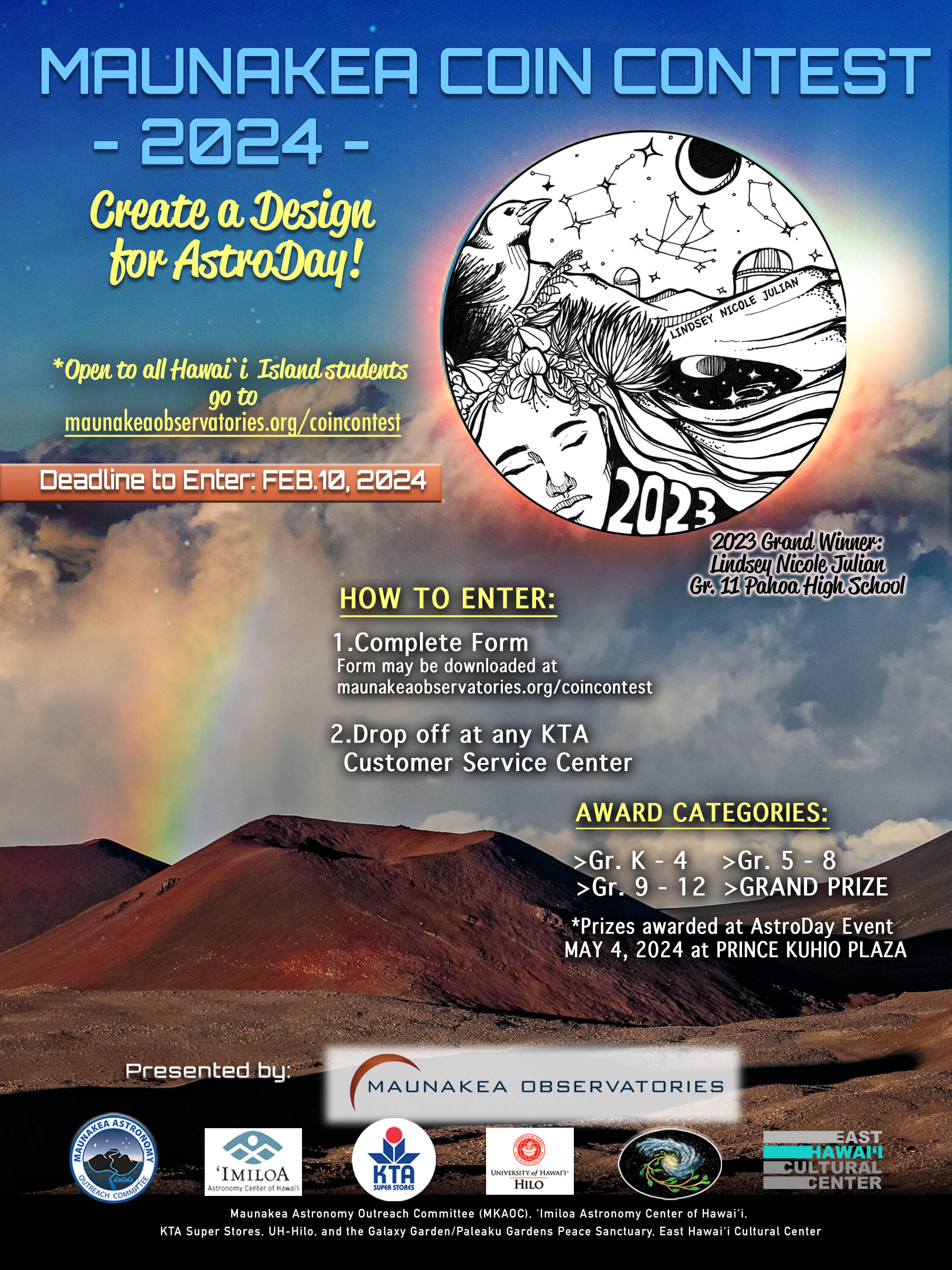
MAUNAKEA COIN CONTEST IS OPEN FOR SUBMISSIONS for youth grades K-12. The deadline to enter is Feb. 10. Entries can be dropped off at at KTA stores. Sponsors are Maunakea Astronomy, Imiloa Astronomy Center of Hawai‘i,  KTA, University of Hawai‘i Hilo, Galaxy Garden/Paleaku Gardens Peace Sanctuary, and East Hawai‘i Cultural Center.
   Students K to 12, including homeschooled children, are asked to make a drawing for a design that can go on a bronze collector’s coin. The coin will be available at the First Light Bookstore at the Visitor Information Station on Maunakea, while aluminum versions will be available at Maunakea Astronomy Outreach Committee events throughout the year. The designs submitted for each year’s contest represent Maunakea and include different aspects of the mountain: its natural resources, astronomy, and culture.
    Entries must use the 2024 Maunakea Coin Contest 2024 Design Sheet.
    Entries will be divided into grades K-4, 5-8, and 9-12 categories. Category judges will select a First, Second, and Third place winner for each of the three grade categories. 

    A Grand Judge will pick the top three overall winners, and the Top Winner will be announced at the annual AstroDay event in Hilo. The Top Winner will see his or her design on the 2024 coin. A bronze version of the coin will be available for sale, and aluminum coins will be distributed at outreach events in the coming year.
    The nine category winners and the best overall 3 entries will receive prizes from KTA Super Stores, the ‘Imiloa Astronomy Center of Hawai‘i, the Galaxy Garden/Paleaku Gardens Peace Sanctuary, East Hawai‘i Cultural Center, and the Maunakea Observatories.
    When creating a coin design, students can get information about Maunakea by consulting the Maunakea Heritage and Natural Resources guide from the Center for Maunakea Stewardship, University of Hawai‘i at Hilo. Download the Design Sheet (PDF). Download the Contest Rules (PDF). Download the hi-res Poster (JPEG). With questions, email events@maunakeaobservatories.org.


Flights over Hawai‘i Volcanoes National Park will be taken on Jan. 19 to detect Rapid ʻŌhiʻa Death and other incipient invasive species in Kahuku, between 2,000- and 4,500 ft. elevation. USGS Photo
FLIGHT OPERATIONS FOR HAWAI‘I VOLCANOES NATIONAL PARK have been announced.
     January 8 between 10 a.m. and 1 p.m. for transporting sling loads and crew for invasive guinea grass control in the coastal backcountry from sea level to 2,400 feet.
     January 11 between 7 a.m. and 2 p.m. for transporting sling loads and crew for invasive guinea and fountain grass control work between sea level and 4,000 ft. elevation from the park's west boundary to Keauhou.
     January 17 between 10 a.m. and 12 p.m. for survey and collection of aerial imagery to detect Rapid ʻŌhiʻa Death and other incipient invasive at the Kīlauea summit and ʻŌlaʻa, between 3,500- and 4,500-ft. elevation.
Invasive banana poka is the subject of an aerial search on Mauna Loa
 on Jan. 24. Photo from Invasive Species Council
    January 19 between 10 a.m. and 12 p.m. for survey and collection of aerial imagery to detect Rapid ʻŌhiʻa Death and other incipient invasive species in Kahuku, between 2,000- and 4,500-ft. elevation.
    January 23 between 10 a.m. and 1 p.m., for survey and control of invasive guinea grass along Keauhou Trail, between sea level and 2,400-ft elevation.
    January 24 between 8 a.m. and 11 a.m., for survey and control of invasive banana poka on Mauna Loa, between 4,000- and 5,000 ft. elevation.
    USGS Hawaiian Volcano Observatory may conduct additional flight operations over Kīlauea and Mauna Loa to assess volcanic activity and maintain instrumentation.
    A statement from the Park says that it "regrets any noise impact on residents and park visitors. Dates and times are subject to change based on aircraft availability and weather. Management of the park requires the use of aircraft to monitor and research volcanic activity, conduct search-and-rescue missions and law enforcement operations, support management of natural and cultural resources, and to maintain backcountry facilities."