About The Kaʻū Calendar

Showing posts sorted by date for query sewage. Sort by relevance Show all posts

Thursday, November 07, 2024

Kaʻū News Briefs Nov. 7, 2024


Dr. Kimo Alameda, Hawai'i County Mayor-elect waves a double shaka with his Co-Campaign Manager, Bill Brilhante, along Kanoelehua Ave. on Election Day. Photo by Tim Wright
MAYOR-ELECT KIMO ALAMEDA, who won almost every precinct and by more than 9,000 votes county-wide this week, said on Thursday that he looks forward to delving into the Kaʻū community to help solve problems and give support.             
    "Dr. Kimo," who is 55, with a PhD in psychology and a career of counseling and running health care and public service agencies for nonprofits and government, said he also wants to thank his Kaʻū Campaign Chair Raylene Auli'i Fujikawa Moses.
    Moses, who coordinated efforts in Kaʻū, said she is so "thrilled that he won, and for what is to come, and what he can do for Hawai'i Island." She noted that he is a supporter of the planned Hawaiian Immersion School in Wai'ohinu, and completing the sewage treatment facilities in Pāhala and Nāʻālehu. She said he has vowed to complete improvements at the parks, including lighting of playing fields, upgrades of the tennis courts in Pāhala and Nāʻālehu, swimming pool in Pāhala, restroom facility at Nāʻālehu Park and needed improvements at Ocean View Park.
Dr. Kimo Alameda, Hawai'i County Mayor-elect,
 receives a lei and a hug from Kaʻū Campaign Chair
 Raylene Auli'i Fuhjikawa Moses on Election Night at
 Nani Mau Gardens. Photo by Tim Wright
   Alameda said that crime, roaming animals and abandoned cars are problems he said he wants to help solve in Ocean View. 
    Alameda noted that he supported the protesters against the proposed Punalu'u development and that as mayor he will do a deep dive into the issue to try to create a solution. He said he has family members on both sides and wants to "study deeper on cost benefits. Get a better pulse of the community."
    Moses said Alameda's forte is "to bring the people together," and to create a positive, civil discussion. She said he has a talent in helping people to feel comfortable so they can talk together to solve problems.        
   Alameda began his campaign almost two years ago and promised to remain "on the ground" with people in each community around the island. He said, "We knocked on doors. It paid off."   
   Alameda said that as Mayor, one of his first tasks is to conduct "a soft informal review of the budget to see what money we got, what is allocated, where more money is needed."

To read comments, add your own, and like this story, see facebook.com/kaucalendar. See upcoming events, print edition and archive at kaunews.com.

THE ART & SCIENCE OF GEOLOGIC MAPPING is the title of this week's Volcano Watch, the weekly article and activity update by U.S. Geological Survey Hawaiian Volcano Observatory scientists and affiliates. This column is by HVO geologist Drew Downs: Geologic mapping has been one of the most fundamental mandates of the U.S. Geological Survey (USGS) since its establishment in 1879. Congress 
created the USGS to "classify the public lands and examine the geological structure, mineral resources, and products within and outside the national domain." The famous western US explorer John Wesley  Powell (also the second director of the USGS) convinced Congress into authorizing the "preparation of the geological map of the United States." The first geologic maps were uniform in size and contained all available information on topography and geology, with accompanying text describing mapped geology.          But sometimes too much information on a map can make it difficult to read and interpret. Modern maps tend to be more versatile; displaying geologic deposits (also commonly referred to as map units) and features of special interest for a project or investigation.
    Modern geologic mapping efforts have centered more around investigations that are deemed of critical importance, such as those vital to energy (oil and gas) and economic (minerals and ore deposits) resources, surface and groundwater resources, urban development and land use. The last one is of particular importance as the Earth is a dynamic place and understanding the locations and ages of past volcanic (lava flows and tephras) and tectonic (faults and fractures) features gives us a blueprint for where and when future activity may occur.
    Geologic maps are not an exact depiction of the Earth's surface. Instead, geologic maps display a generalization of interested units and features in correspondence with the scale of a map. If mapping is done at a small scale, which would be zoomed out to show a large area, then smaller geologic units and features might not be able to be accurately displayed. In the end, everything depends on the scale being used and what the geologic mapper is trying to portray.
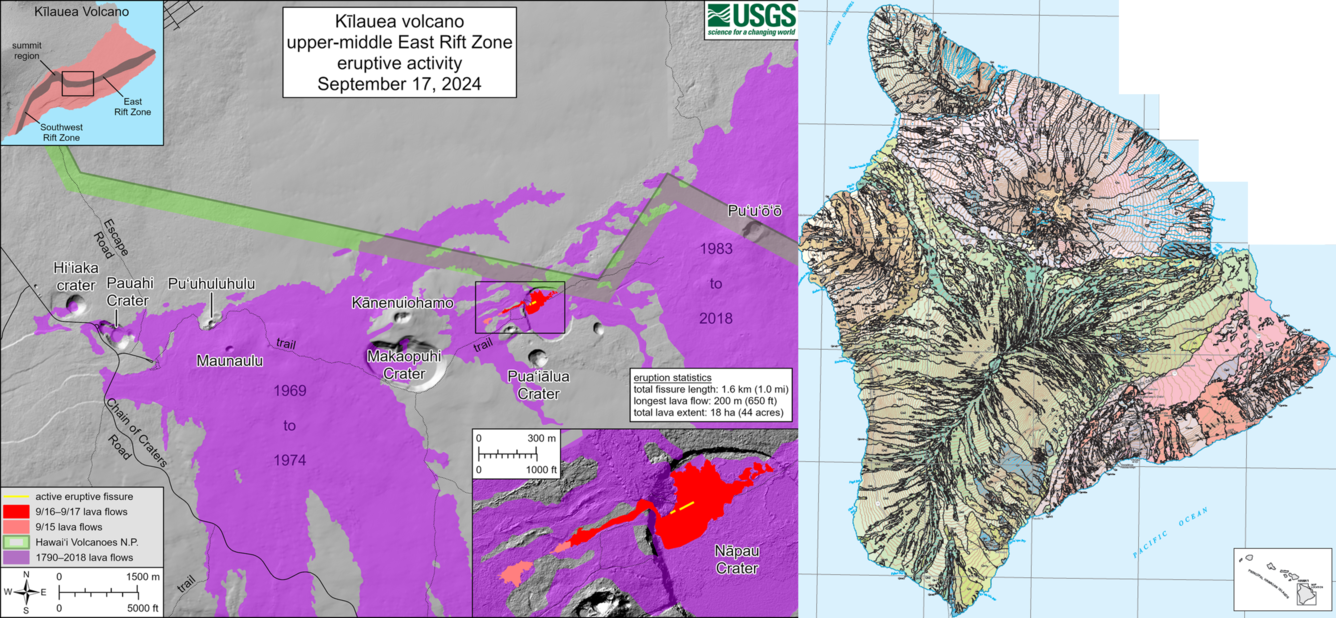
Color graphic showing two geologic maps side by side
Examples of Hawaii geologic maps. The lefthand map is a USGS Hawaiian Volcano Observatory map created on September 17, 2024, within hours of remote sensing (helicopter overflight) of the eruption that occurred from September 15–20, 2024. Several age ranges for lava flows of interest are noted by color changes, with those that erupted from 1790–2018 in purple (older lava flows are gray), those erupted on September 15 in pink, and those erupted September 16–17 in red (with the active fissure as a yellow line). This map also shows roads and the boundary of Hawaiʻi Volcanoes National Park, as these would be of interest to those using this map. The righthand geologic map is that of the Island of Hawaiʻi from the Geologic Map of the State of Hawaii by Sherrod and others (2021). This map was compiled through decades of work and displays the various lava flows, tephra deposits, and other rock and sediment types mapped through fieldwork and remote sensing. The primary purpose of this geologic map is to show all mappable geologic units with their colors denoting their source volcano and age. This map is free to download at https://pubs.usgs.gov/publication/sim3143.
    In the case of USGS Hawaiian Volcano Observatory geologic mapping on the Island of Hawaiʻi, the primary map units of interest are volcanic vents (such as fissures and scoria cones) and their associated lava flows and tephra deposits divided by age. It's easy to make these determinations for young eruptions that have been witnessed, with eruptions over the last few years being mapped within hours or days of activity starting using Geographic Information Systems (GIS) software. Remote sensing techniques using aerial and satellite imagery have also made this much quicker.
Book Review: The Perils of a Pathfinder - WSJ
John Wesley Powell, explorer and second director of USGS, convinced Congress
to authorized "preparation of the geological map of the United States."

   While some older lava flows can be mapped using remote sensing, others exposed to the elements for hundreds or thousands of years can be harder to tell apart. Therefore, diagnostic criteria from the field or lab is usually required to distinguish their geographic extents when compiling a geologic map. Geologists make field excursions to document minerals present in the lava flows and their abundances, and collect samples to analyze chemistry, radiometric ages, and paleomagnetism. Usually, a combination of these is needed to put together a full picture on a map sheet.
    For geologic maps published by the USGS, there is a standardized set of symbols, patterns, and colors that are used: the Geologic Map Schema, or GeMS for short. Whereas symbols and lines tend to be objective on a geologic map (for example, set line thicknesses, styles for things line contacts, faults, and ground cracks), colors used for geologic map units can be more subjective. It is common for geologic maps that portray volcanic terrains with young lava flows and tephras to have the 'hottest' colors, such as reds and oranges, and those colors gradually get 'cooler' going to greens, blues to purples as the map units get older. This is makes it easy to glance at a geologic map and get a quick sense of the relative age of volcanic activity.
    These USGS geologic maps are generally printed but all are now also published as GIS digital databases that are freely available to be downloaded. A recent geologic map addition to get a sense for scale, color, and symbology used is the Geologic Map for the State of Hawaii and its digital database published in 2021. The next time you are looking at a geologic map, you can appreciate both the art and science that went into its presentation.

To read comments, add your own, and like this story, see facebook.com/kaucalendar. See upcoming events, print edition and archive at kaunews.com.

Volcano Activity Updates
    

USGS Volcanoes🌋 (@USGSVolcanoes) / X

Kīlauea is not erupting. Its USGS Volcano Alert level is ADVISORY.
    Over the past week, earthquake rates beneath Kīlauea summit and upper-to-middle East Rift Zone were slightly lower than the previous week. About 25 earthquakes were located beneath the summit, and about 70 were located in the upper-to-middle East Rift Zone. Ground deformation rates continue to show slow inflation at the summit and near the September 15-20 middle East Rift Zone eruption site. Future intrusive episodes and eruptions could occur with continued magma supply.
   Mauna Loa is not erupting. Its USGS Volcano Alert Level is at NORMAL.
    A brief increase in earthquake activity at Kamaʻehuakanaloa volcano (formerly Lōʻihi Seamount) took place November 1-2. More than 100 events were detected, the largest of which was a M4.3. Activity could have been related to magma movement, but past eruptions at Kamaʻehuakanaloa have been accompanied by thousands of earthquakes over days to weeks.
    One earthquake was reported felt in the Hawaiian Islands during the past week: a M4.8 earthquake 5 km (3 mi) SW of Pāhala at 38 km (23 mi) depth on Nov. 5 at 1:42 a.m. HST. This event was part of the ongoing swarm of deep seismicity that has been occurring beneath the Pāhala area since 2019
    HVO continues to closely monitor Kīlauea and Mauna Loa.

To read comments, add your own, and like this story, see facebook.com/kaucalendar. See upcoming events, print edition and archive at kaunews.com.

HPD ARRESTED 16 FOR DUI during the week of Oct. 28 through Nov. 3. Hawai`i Police Department made the arrests for driving under the influence of an intoxicant. Nine of the drivers were involved in a traffic accident. Two were under the age of 21.
    So far this year, there have been 814 DUI arrests compared with 805 during the same period last year. This is an increase of 1.12 percent.
    HPD’s Traffic Services Section reviewed all updated crashes and found 832 major crashes so far this year, compared with 711 during the same time last year. This represents an increase of 17 percent.
    To date, there were 23 fatal crashes, resulting in 25 fatalities (two of which had multiple deaths, one was reclassified as suicide, one reclassified as a medical condition, and two died at a later date), compared with 13 fatal crashes, resulting in 14 fatalities (one of which had multiple deaths, one died at a later date, and one crash reclassified as a medical condition) for the same time last year. This represents an increase of 76.9 percent for fatal crashes and 78.6 percent for fatalities.
   To date, the non-traffic fatality count so far this year is 0 compared to 0 non-traffic fatalities (not on a public roadway) for the same time last year.
   HPD promises that DUI roadblocks and patrols will continue island wide.

To read comments, add your own, and like this story, see facebook.com/kaucalendar. See upcoming events, print edition and archive at kaunews.com.


KĪLAUEA MILITARY CAMP WILL HOST VETERANS DAY observance and celebration with ceremonies at 10 a.m. next Monday, Nov. 11. Keynote speaker will be Lt. Col. Christopher Marquez, Commander of Pohakuloa Training Area. 
    Lunch will be at Crater Rim Cafe from 11 a.m. to 1 p.m. and a Veterans Expo from 11 a.m. to 1 p.m.
     The lunch costs $38 per person for adults and $19 for Keiki ten years and under. Reservations can be made and paid for by calling 808-967-8333.
    
KAʻŪ MULTICULTURAL SOCIETY WILL CELEBRATE VETERANS DAY, next Monday, Nov. 11 from 10 a.m. to 2 p.m. with a display of Kaʻū veterans photos and other memorabilia at Nāʻālehu Park next to the World War II Veterans Memorial.

OKK WILL CELEBRATE VETERANS DAY NEXT MONDAY, NOV. 11  from 10 a.m. to 2 p.m. Free lunch for veterans and their families, with music by Keoki Soriano. Venue is the 'O Ka'ū Kākou Market in Nāʻālehu.


Tuesday, October 29, 2024

Kaʻū News Briefs Oct. 28, 2024

The new Pāhala wastewater treatment plant is soon to be under construction, set back from the pine tree entrance to the village on Maile Street. Macadamia orchards will be irrigated with treated water. Image from County of Hawai'i

PĀHALA  SEWER PROJECT TO BEGIN CONSTRUCTION: The Implementation Plan for the new wastewater, sewage system for Pāhala was submitted to the EPA on Oct. 24 by County of Hawai‘i. The County also announced awarding the construction contract to Goodfellow Brothers, Inc., with work anticipated to be approximately 18 months, beginning in January. Read the Implementation Plan at https:// www.dem.hawaiicounty.gov/home/ showpublisheddocument/308434. 
    The Implementation Plan describes the remaining planning, design, and construction schedule for the package wastewater treatment plant and new collection system, following EPA’s approval of the Final Environmental Information Document. 
    The County is overseeing the design and engineering, and the acquisition of necessary land and easements, for the collection system, treatment plant, and disposal system. Owners of homes in the affected area will have received via USPS a right-of-entry agreement for the construction of the new collection system. The County asks that owners sign the agreement and return it to the County in the enclosed envelope. 
   With questions, call the phone numbers listed in the letter. The final deadline for the County to close the large capacity cesspools is January 22, 2027. Those cesspools are illegal nationally and are left over from the sugar plantation days.

Moses Kaho'okele Crabbe and his halau will  perform at Ho'okupu Hula No Kaʻū Cultural Festival on Saturday, Nov.2.

FIVE HALAU WILL GRACE HO'OKUPU HULA NO KA'U CULTURAL FESTIVAL this Saturday, along with musical performers and cultural practitioners. Kumu Debbie Ryder said she welcomes hālau from afar and near and headliner singer Ku‘uipo Kumukahi along with the musical group He Mea Hou, led by Victor Chock. 
   The free event begins at 9 a.m. at Ke Ola Pu‘uhonua grounds in Nā‘ālehu, with Pule and Ho‘okupu, with Ku‘uipo Kumukahi at 10 a.m. She is followed by: 
    Hālau O Kaleo A Keahialapalapa with Kumu Hula Naoho Kanahele along with musical performers and cultural practitioners. Kumu Debbie Ryder said she welcomes halau from afar and near and headliner singer Ku'uipo Kumukahi along with the musical group He Mea Hou, led by Victor Chock.
    The event begins at 9 a.m. with Pule and Ho'okupu. Ku'uipo Kumukahi at 10 a.m. She is followed by:
    Hālau O Kaleo A Keahialapalapa with Kumu Hula Naoho Kanahele, Kanakaole, great granddaughter of Aunty Edith Kanakaole;
    Hālau Na Pua O Uluhaimalama with Kumu Hula Emery Acerat, whose ʻūniki is from the Late Ray Fonseca;
    Hālau Hula ‘O Leionalani with Kumu Hula Debbie Ryder whose ʻūniki is from the late Loea George Lankilakeikiahiali‘i Naope; 
    Ho‘omaika‘i Hula Studio with Kumu Hula Shona LamHo, an O‘ahu Hula sister of Debbie Ryder; 
    Hālau Auolaokalani with Kumu Hula Moses Kaho‘okele Crabbe.
    Cultural practitioner demonstrations include: Net Making with Uncle Chucky Leslie of Nāpō‘opo‘o;
    Poi pounding and demonstrating with Bobbie Pahia from Maui and Kawehi Ryder of Pāhala; 
    Medicinal Awa (Kava) with Todd Reilly. 
    There will also be food and vendor booths. The Saturday festival is followed by a free Kulia I Ka Nu‘u Health Fair from 10 a.m. to 2 p.m. on Sunday at the same location, sponsored by Hawaiian Music Perpetuation Society. It includes La‘au lapa‘au, health screening, food demonstrations, resource provider demonstrations mele and hula.

Ku‘uipo Kumukahi headlines the  cutlural fest at Ke Ola Pu‘uhonua grounds in Nā‘ālehu this Saturday.
To read comments, add your own, and like this story, see facebook.com/kaucalendar. See upcoming events, print edition and archive at kaunews.com.


Sunday, October 13, 2024

Kaʻū News Briefs Oct. 13, 2024


Comet A3 Tsuchinshan-ATLAS as seen from Maunakea. See more below. Image from EarthSkyScience
THIS MONTH: SKY GAZERS FROM KAʻŪ and the rest of citizens of planet Earth are treated to the arrival of a special celestial visitor, Comet A3 Tsuchinshan-ATLAS, with photographers capturing the image from Kilauea Military Camp on Sunday evening.
Atlas Comet as seen Sunday evening from Kīlauea
Military Camp. Photo by Thea Calumpit
     Here is the explanation from Volcano resident and astronomer for Hawai'i Public Radio and Kaʻū Night Skies, Christopher Phillips: 
    The comet was discovered in February 2023, by the Asteroid Terrestrial-impact Last Alert System (ATLAS) sky survey. ATLAS has telescopes in both Hawaii and South Africa, enabling it to cover both the northern and southern hemispheres. 
     Comet A3 is currently visible in northern latitudes during sunset onwards. Its position in the sky, relative to the setting Sun, makes it a little tricky to spot, as sky conditions near the western horizon need to be quite clear. Once the Sun has set however, it should be visible to the naked eye as the sky darkens. Through a pair of binoculars or a small telescope, it should present quite the sight. To find the comet, look to the west and to the setting stars of Orion, if you are familiar with the faint constellations in that region, you will find the comet in the small constellation of Corona Borealis (The Northern Crown). See the finder image in this post for a helping hand. 
 
       The comet itself is quite fascinating. It's large, with a nucleus that's around 2 miles wide, almost as large as the object that wiped out the Dinosaurs, 65 million years ago. During its closest approach to the Earth it is around 44 million miles away from us, so nothing to worry about in terms of it impacting the Earth.            
    This is the first time in 80,000 years that Comet A3 Tsuchinshan-ATLAS has been visible to the inhabitants of planet Earth, and once it leaves our skies it won't be seen for another 80,000 years, so see it while you can! This type of comet is known as a 'long period' comet, because of its long orbital period around the Sun, in this case 80,000 years.
Image from The Sky Live https://theskylive.com
    Comets such as A3, along with the many asteroids in our skies, are left over construction material from the formation of the Solar system.
    However, there is one major difference between the two types of objects. Asteroids are mostly composed of rock and metals, comets on the other hand are dirty snowballs, mainly made of ice with some dirt thrown in for good measure. Comets in particular are thought to have been a major source of water in the early history of the Earth, bringing it to the surface during impacts.
    Seeing these beautiful celestial visitors in our skies is a reminder of the profound beauty of the cosmos, and also that the Solar system is still under construction, it is by no means finished. It's an enormous construction site with Mother Nature as the site foreman, and she's got plenty more work to do.

To read comments, add your own, and like this story, see facebook.com/kaucalendar. See upcoming events, print edition and archive at kaunews.com.

THE LOCATION OF THE PLANNED NĀ’ĀLEHU SEWAGE PLANT DREW SOME QUESTIONING from Ala Kahakai's Waikapuna manager Keoni Fox during the county's public meeting last Thursday on the Draft Environmental Information Document. Public comments can be made by Oct. 21 by emailing publiccomment@wilsonokamoto.com.
    Fox said that the county Department of Environmental Management has called for the condemnation of 28 acres of the Waikapuna land purchased for conservation with taxpayer money. The 28 acres, adjacent to the town of Nā'ālehu, is within the 2,317 acre Waikapuna preserve stewarded by the Ala Kahakai Trail Association.   

     Fox suggested that other lands be considered for the sewer plant, now that the county has chosen what he called an industrial style package plant rather than a system with lagoons friendly to native plants and wildlife. He pointed to adjacent properties that he said are owned by Eva Liu, Christina Taylor and partners and Michelle Galimba.
    Environmental Management Deputy Director Brenda Iokepa-Moses, who led the meeting, said that the 28 acres is a small portion of the 2,317 acres that has been preserved and that using that small portion to solve the sewer problem in Nā'ālehu would benefit the community. It is required by federal law that the old polluting gang cesspool system be abandoned. She stressed that time is of the essence, with the county on a deadline to get the old sugar camp houses off the gang cesspools.
    She pointed out that $4 million towards buying the Waikapuna preserve came from the County of Hawai'i's Public Access, Open Space & Natural Resources Preservation Program. She stressed that the county has decided through soil sampling and other studies that the 28 acres is the best location. She said it has been considered as the site for the project for years and that no other properties are being considered for the initial sewer plant. She also said no private money is involved.
    Fox also pointed to the use of tax money to purchase the 2,317 acres but stressed that it was specifically for conservation. The acquisition was to preserve the Waikapuna coast, the 2.3 miles of Ala Kahakai Trail along the coast, and adjacent lands. In addition to the county helping to purchase the preserve, the state Legacy Land Conservation Program contributed $2 million. He said that discussions of the 28 acres for the treatment plant during the time of purchase, were in the context of it being the lagoon system that would also serve wildlife.
    Another speaker asked whether the proposed site would interfere with public access to Waikapuna. Iokepa-Moses said it wouldn't and that access was from a different location.
    One speaker asked whether existing but unused underground piping among the houses could be used and whether it would be able to handle the new sewer system. Iokepa-Moses said the pipes will be inspected and if unusable would be capped and left in place with new sewer pipes installed beside them. She said that the county is fully responsible for the maintenance of the current and new system from the houses to the sewer plant.
    Nā'ālehu Draft Environmental Information Document (Draft EID) is available at the Nā'ālehu Public Library, and also on the website for Department of Environmental Management projects: www.dem.hawaiicounty.gov/projects.

 To read comments, add your own, and like this story, see facebook.com/kaucalendar. See upcoming events, print edition and archive at kaunews.com.
Zonta's Pay it Forward Committee Wilma Matsumura, Jessic Gauthier and Laurie Higashi with 2024 Pay it Forward microgrant recipients Dawn Patterson on screen, Rachel Erdman, Napua Arakaki-Heen, Megan Brady and Syd Wang. Photo from Zonta

TEN THOUSAND DOLLARS IN PAY IT FORWARD MICROGRANTS has been distributed for 2024 by The Zonta Club on Hawai'i Island. The award program supports women entrepreneurs who are starting a new business or working to expand an existing business.
    "For the third year in a row, we saw a record number of applicants for the grant. It's inspiring to see so many women entrepreneurs in our community," said Zonta president Julie Tulang. She said Zonta "is proud to provide a financial boost to these five well-deserving women-owned businesses."
    Pay It Forward microgrants are funded annually through the charitable Zonta Club of Hilo Foundation, donations to which are tax-deductible. 
    The 2024 microgrant recipients are Dawn Patterson of Dawn's Barber Shop, Rachel Edrman of LoveBug Farm LLC, Napua Arakaki-Heen of Nalani Farm Store, Megan Brady of Uproot Origin LLC, and Syd Wang of Wala'au Therapy LLC.
   Patterson has been a barber for 29 years and is sole proprietor of Dawn's Barber Shop in Hilo. She will use the grant to pay off her EIDL COVID loan and purchase tools for the shop.
    Erdman's LoveBug Farm raises hydroponic lettuce, microgreens, and produce as well as provides dog daycare, boarding, and training services. She will use the money to build a sink and a cleaning and processing area for the produce grown on her farm.
   Arakaki-Heen's Nalani Farm Store, located in downtown Hilo, is a boutique gift shop specializing in goods grown, made, and designed in Hawai'i. She estimates that around 70% of the products she stocks are produced by women-owned businesses. She will use the funds to purchase inventory for the store.
    Brady created her signature Uproot Origin elixir from organic ginger, organic turmeric, and organic honey sourced from small farms on the Big Island. She plans to use the grant to hire administrative support to help her business grow.
    Based in Hilo, Wang's Wala'au Therapy evaluates and treats speech, language, cognitive, and swallowing/feeding disorders. She plans to use the award to build an ADA-compliant entrance ramp at her practice.
    For more on Zonta and to donate, visit zontahilo.org.


5,000 in the mail, 2,500 on the street.


Tuesday, October 08, 2024

Kaʻū News Briefs Oct. 8, 2024

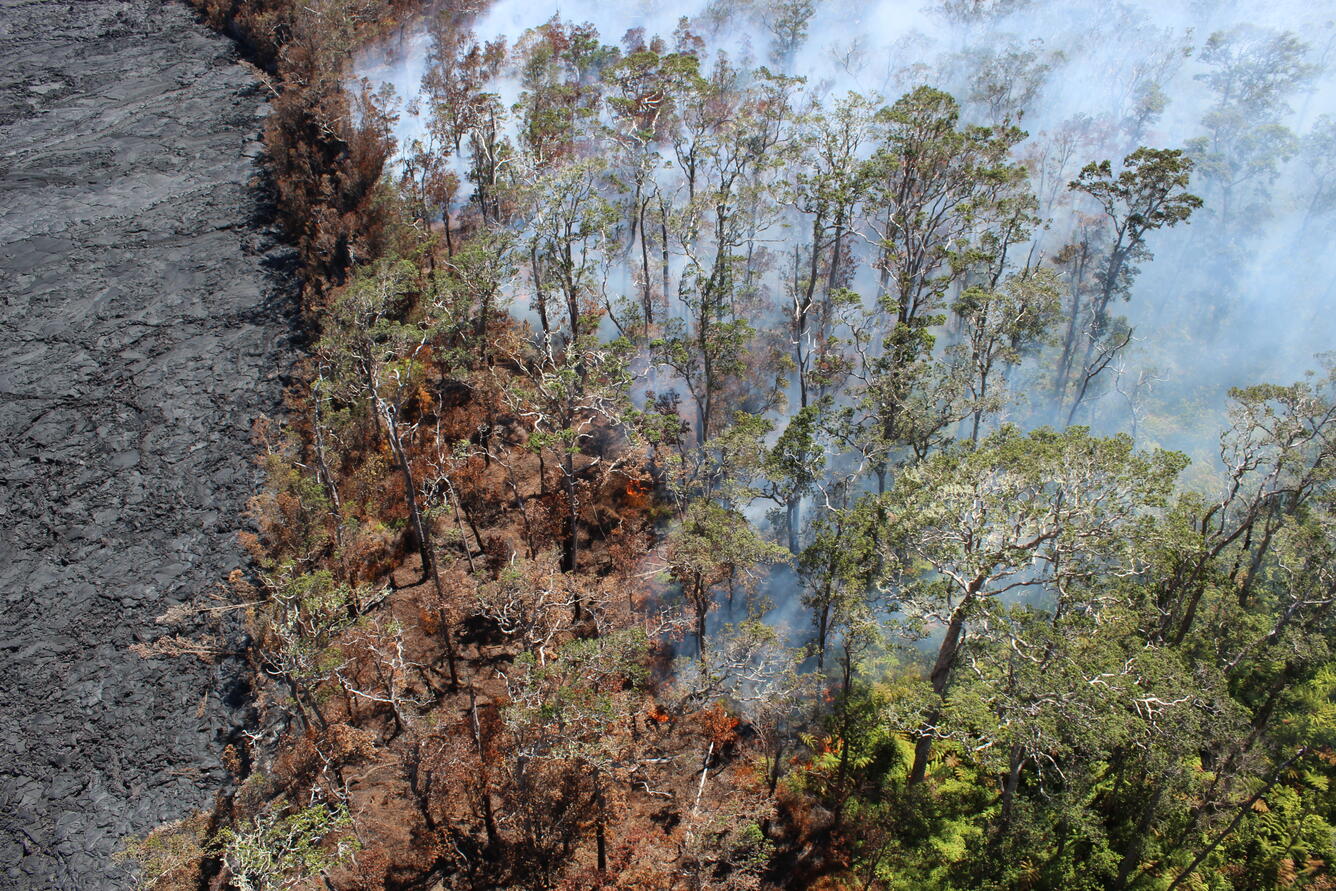
Color photograph of fire in vegetation near crater
On the middle East Rift Zone of Kīlauea, a recent eruption covered a large portion of the Nāpau Crater floor with new
  lava—dark gray lava near center of image. This eruption started a forest fire that continues to burn vegetation along the
 southern rim of Nāpau Crater. Photo view looking northwest with Kānenuiohamo visible in the upper left.
USGS photo taken on Oct. 7 by L. DeSmither

TO SUPPRESS WILDFIRES, MANAULA AND NĀPAU TRAIL PARKING LOTS ARE CLOSED temporarily in Hawai'i' Volcanoes National Park. The areas are off limits to vehicles, pedestrians and cyclists.
    The remote 78-acre Makaopuhi Fire was ignited by the September 15 eruption of Kīlauea volcano. Fire activity has increased due to lack of recent rainfall, low humidity and wind. Twenty-two members of the Pacific Islands Fire Management team, which includes firefighters from Hawaiʻi Island and American Sāmoa, are constructing a fire line to gain control of the fire's spreading perimeter. Firefighters are supported by helicopter water drops. A staging area, helispot and temporary dip site are located near the Maunaulu parking lot.
    The fire was located on the south rim of Nāpau Crater following the recent eruption on Kīlauea’s middle East Rift Zone, within Hawai‘i Volcanoes National Park. Beginning around 4 p.m. HST on Oct. 6, a smoke plume from the burning vegetation became visible in HVO webcam imagery, and intermittent incandescence was seen overnight. There were no indications of renewed eruptive activity from geophysical monitoring signals. On Oct. 7, an overflight confirmed that the smoke and glow were due to a forest fire.
    The temporary closure at Maunaulu is expected to last through Wednesday, Oct, 9 but could be extended if fire spread continues. The fire, which does not have a continuous flaming front, continues to burn pockets of uluhe fern and other vegetation dried by recent volcanic activity in Hawaiʻi Volcanoes National Park. It poses no threat to homes at this time.
    The fire is a threat to Hawaiian ecosystems and rare plants in the area. The remote location and the hazardous volcanic terrain in Kīlauea volcano's remote East Rift Zone increase the difficulty of fire suppression efforts.
Color photograph of wildfire near crater
A wildfire started by a lava flow has drawn firefighters from American Samoa and Hawai'i Island.
Photo by L. DeSmither


To read comments, add your own, and like this story, see facebook.com/kaucalendar. See upcoming events, print edition and archive at kaunews.com.

UP TO THREE ADDITIONAL HOUSING UNITS WILL BE ALLOWED ON EACH LOT to address the housing shortage on the island. Mayor Mitch Roth announced the signing of County Council Bill 123 on Tuesday. It's a piece of legislation aimed at increasing housing inventory on residential and agriculture properties across Hawai'i County. The bill, co-drafted by Council Chair Heather Kimball, Councilwoman Ashley Kierkiewicz, Planning Director Zendo Kern, and Deputy Director Jeff Darrow, allows homeowners to build up to three accessory dwelling units (ADUs) with a size limit of 1,250 sf on their properties, helping address the county's housing shortage and enabling local families to stay in Hawai'i.
    "Bill 123 is a significant step toward expanding housing opportunities on Hawaiʻi Island," said Kierkiewicz. "By allowing more ADUs in urban areas, we're encouraging smart growth within our communities. This practical solution not only increases housing availability, but also empowers residents to actively contribute to addressing our island's housing shortage."
    "Hawaiʻi County is leading the way with Bill 123. ADUs offer a flexible and affordable housing solution for our residents," said Kimball. "Building ADUs for parents, children or long-term renters can help families stay together here on the island and can help homeowners generate extra income needed to get by. By encouraging development of existing properties in urban areas close to school, work, and commercial areas, ADUs also promote more sustainable land use practices outside the urban core."
     The Mayor's announcement said the bill introduces new provisions that replace previous restrictions on "ʻohana dwelling units," providing more flexibility for homeowners to add ADUs. Key amendments include:
    Allowing ADUs, whether detached or attached, to be built alongside single-family homes in Residential (RS), Duplex (RD), Residential-Agricultural District (RA), Agricultural (A), and Family Agricultural (FA) districts.
    Limiting each property to a maximum of three ADUs.
    Ensuring compliance with infrastructure and safety standards, including requirements for sewage disposal and water supply.
    Restricting the use of ADUs for transient accommodations, with limited exceptions.
    "The ability to build additional dwellings on existing properties is essential in addressing our housing shortage, but it's also about preserving our communities and ensuring that future generations—our keiki—can continue to live and thrive here in Hawai'i," said Roth. "This bill expands our housing inventory in a way that is both sustainable and community-centered."
    The statement said Bill 123 reflects Hawai'i County's commitment to tackling the housing crisis while promoting long-term stability and sustainability.
    For more information on the new ADU provisions or to learn how to apply for building permits, contact the Planning Department at planning@hawaiicounty.gov.


To read comments, add your own, and like this story, see facebook.com/kaucalendar. See upcoming events, print edition and archive at kaunews.com.

5,000 in the mail, 2,500 on the street.


Friday, September 20, 2024

Kaʻū News Briefs Sept. 20, 2024

Kīlauea Eruption Spatters, Sputters & Stops
USGS Hawaiian Volcano Observatory field crews reported small fountains and lava flows erupting from one of the western fissures just before 9 a.m. on Friday. By 10 a.m., that activity had ceased and the middle East Rift Zone eruption of Kīlauea had paused. USGS photos by M. Patrick.
USGS Hawaiian Volcano Observatory field crews reported small fountains and lava flows erupting from one of the western fissures just before 9 a.m. on Friday. By 10 a.m., that activity had ceased and the middle East Rift Zone eruption of Kīlauea had paused. USGS photo by M. Patrick.

ONE NEW AFFORDABLE HOUSING BILL WOULD CREATE SPRAWL in Hawai'i County and unintentionally fail to solve the affordable housing problem, according to Jason Masters, an urban planner who grew up in Kaʻū and lives here. He sent a letter, representing only himself, to Mayor Mitch Roth, who could veto Bill 123, following its recent passage by the County Council. Masters also presented his concerns to the Kaʻū Community Development Plan Action Committee at this week's meeting. Masters is Chair of the Action Committee and asked members to weigh in on the matter 
    While he said he does "admire the intention and direction taken by the County Council to address the  complex problems of affordable and available housing on our Hawai’i Island," he wrote that Bill 123 would "actually result in just the opposite of what it hopes to accomplish." He referred to the possibility of investors coming into communities and buying up land with the higher housing density approval, to construct multiple expensive, large houses instead of helping to solve the local housing shor

Jason Masters, Chair of Kaʻū Community Development Plan Action Committee.
  He said some of the many unknown adverse effects of this bill include problems with traffic and circulation. He contended it could triple the potential population "without accounting for general infrastructure, on and off-site parking, sewage which is a significant issue in Kaʻū of which we are awaiting resolution, water supply, energy" and more.
    He called for the bill to be held back in order for Action Committees around the island to study it and make recommendations. He also noted that the county's General Plan is under revision and questioned why Bill 123 is a separate item that was rushed through the County Council. He said Bill 123 was "poorly advertised when it probably has much more drastic, immediate impacts" than the General Plan update.
    Masters said that in his 15 years as a City Planner in California before he moved back home to Kaʻū, he wrote many laws regarding accessory dwelling units, which were never for more than one additional unit 

on one property for a habitable use, and never for anything close to over 1,000 sq. ft.; could never exceed the existing dwelling size; and never used for less than long term rental.
    He asked why Bill 123 was "so urgently rushed through. I believe in finding solutions to affordable housing islandwide. But I believe that they have to be varied and targeted solutions as appropriate. I work at the schools in Kaʻū. I want somewhere for these kids and, heck, for their parents right now to be able to live affordably." He said that "given the opportunity, the District of Kaʻū’s Community Development Plan Action Committee would certainly discuss and provide testimony on this item." Masters urged to "Please delay action on this item until such time is given to allow the County’s Action Committees to act on this matter as I believe is consistent with County Law."
    The result of Bill 123, predicted Masters, "will be to forever price out future generations of existing residents and lock them into being forever-renters." He noted that currently Kaʻū District has among the highest homeownership rates in the state even with lowest income levels in the state. "With this Bill, outside investors will come in and buy up cheap lots, and develop them for multifamily housing rentals which will drive up land values, pricing out local families forever." He said that the result of Bill 123 "is to literally encourage urban sprawl just like Los Angeles. Please reconsider the far reaching implications of Bill 123."

To read comments, add your own, and like this story, see facebook.com/kaucalendar. See upcoming events, print edition and archive at kaunews.com. Support this news service with advertising at kaunews.com. 7,500 copies in the mail and on stands.

Andrew Amon
POLICE ARE LOOKING FOR ANDREW AMON, a 28-year-old Kaʻū man who is wanted on an outstanding bench warrant, and for questioning in connection with other criminal investigations.
    Amon is described as being 5-foot-five inches tall, 130 pounds with brown eyes and black hair and is known to frequent the area of Hawaiian Ocean View Estates.
Anyone with information on Amon’s whereabouts is encouraged to contact Officer Jenna Kosinski-Santos at (808) 939-2520 or via email at Jenna.Kosinski-Santos@hawaiicounty.gov. They may also contact the Hawaii Police Department’s non-emergency number at (808) 935-3311.

To read comments, add your own, and like this story, see facebook.com/kaucalendar. See upcoming events, print edition and archive at kaunews.com. Support this news service with advertising at kaunews.com. 7,500 copies in the mail and on stands.                                                                                                                                          THE TENTH ANNUAL KAʻŪ COFFEE TRAIL RUN is Saturday starting and finishing at Kaʻū Coffee Mill on Wood Valley Road above Pāhala. Events are a 5K, 10K, half marathon and 50K. Competitors will run through coffee and macadamia orchards and up into the rainforest above Wood Valley Road. The 50K starts at 6 a.m., followed by the half marathon at 7 a.m., 10 K at 7:15 a.m. and 5K at 7:30 a.m. Proceeds support the community group ʻO Kaʻū Kākou. Registration is  closed but the public is invited to see the start and finish and to enjoy food and refreshments as well as visit Kaʻū Coffee Mill.

To read comments, add your own, and like this story, see facebook.com/kaucalendar. See upcoming events, print edition and archive at kaunews.com. Support this news service with advertising at kaunews.com. 7,500 copies in the mail and on stands.    


September 2024, 5,000 in the mail, 2,500 on the streets.